


Selling an Inherited House As-Is in Baltimore County: Why Renovating Isn't Always the Best Decision
By Dan McDevitt | RealVolution Homes Group | Cummings & Company Realtors
When someone inherits a house in Baltimore County, one of the first questions that often comes up is:
"Should we fix the house up before selling it, or would we be better off selling it as-is?"
It's a reasonable question, especially when the property belonged to a parent or family member who lived there for decades.
Maybe the kitchen hasn't been updated in years. The carpeting is older, the paint and wallpaper are dated, or the floors need attention. The family starts making a list of improvements, and before long, they're wondering whether they need to spend $20,000, $30,000, or more just to get the house ready for the market.
But here's something I've learned after more than 20 years in real estate:
Just because a house needs updating doesn't mean renovating it before selling is the best financial decision.
Sometimes the opportunity is in the property exactly as it sits.
A Real Estate Example: An Estate Property in Dundalk, Maryland
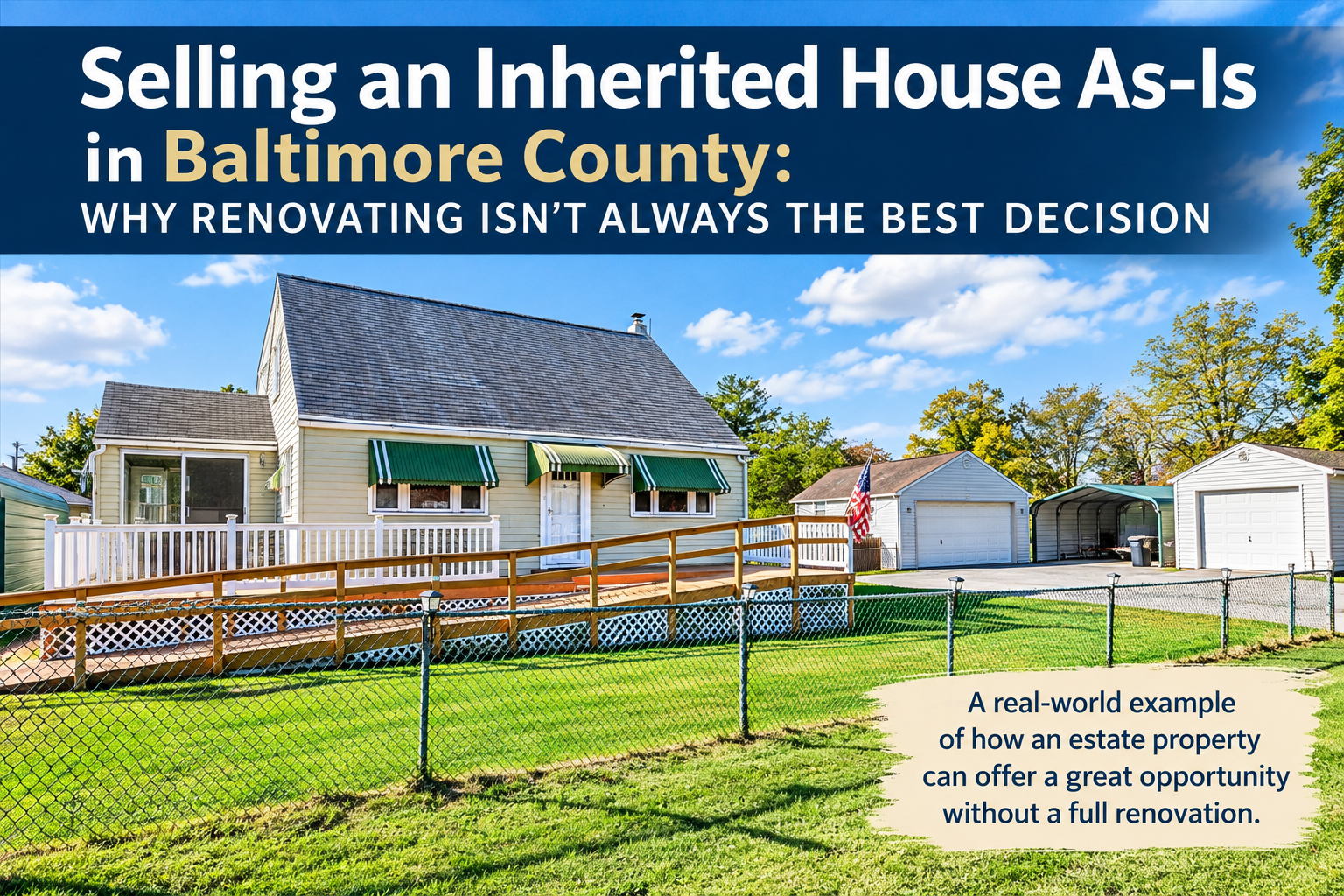
I'm currently preparing an estate property at 3701 North Point Boulevard in Dundalk, Baltimore County, and it's a good example of why I believe every inherited home deserves an individual evaluation before anyone starts spending money on renovations.
The property is a three-bedroom detached Cape Cod with approximately 1,193 square feet of above-grade living space and an additional 752-square-foot unfinished basement.
The interior has areas that would benefit from updating. There are older finishes, carpeting, and flooring that a new owner may want to address.
But here's what caught my attention when evaluating the property.
It's a detached single-family home with a spacious fenced-in yard, two detached garages, a carport, a large deck, and an enclosed porch with sliding glass doors.
Those features are important.
While buyers can replace carpeting, paint walls, or remodel a kitchen, finding a detached home with this kind of outdoor space, parking, and storage can be considerably more challenging.
The property's greatest selling points aren't necessarily inside the house. They're the things that may be difficult or expensive for a buyer to find somewhere else.
That's a completely different way to look at the property's potential.
The Mistake Families Sometimes Make With Inherited Homes
When families inherit a property that hasn't been updated in years, they often compare it to beautifully renovated homes they see online.
They see new kitchens, luxury flooring, fresh paint, and updated bathrooms.
Naturally, they begin thinking they need to do the same thing to compete.
But there are several questions I encourage families to consider before making that decision.
How much will the renovations actually cost?
How long will the work take?
Who is going to manage the contractors?
Will the improvements increase the property's selling price enough to justify the expense?
And perhaps most importantly:
Is there already a buyer willing to purchase the home in its current condition at a price that makes sense for the estate?
That last question is frequently overlooked.
Selling As-Is Doesn't Mean Selling Only to Cash Investors
One misconception I encounter is that a house needing work must automatically be sold to an investor at a deeply discounted price.
That's not necessarily true.
There are buyers who would rather purchase a home at a more affordable price and make improvements over time.
Think about a first-time buyer who has been searching for a townhouse because detached single-family homes seem out of reach.
What if that buyer could purchase a detached home with a fenced yard, garage space, and additional storage for a price comparable to some townhomes?
The home might need new flooring, fresh paint, or kitchen updates. But the buyer may see an opportunity to make those improvements gradually and build potential sweat equity.
Of course, the property still needs to meet the requirements of the buyer's financing program, and not every repair can be postponed. Some buyers may need a renovation loan or another financing solution.
But the important point is that investors aren't necessarily the only audience for an estate property that needs updating.
Why Renovations Don't Always Produce a Dollar-for-Dollar Return
Let's look at a hypothetical example.
Suppose a family is considering spending $30,000 updating an inherited house.
After evaluating comparable properties, the local market, and the improvements being proposed, we determine that the renovations might increase the selling price by $35,000.
At first glance, that sounds like a $5,000 gain.
But what about the additional holding costs, utilities, insurance, property taxes, contractor delays, unexpected repairs, and the time involved?
What happens if the project costs $40,000 instead?
And what if the market changes while the work is being completed?
That's why I don't believe families should automatically renovate an inherited home simply because it needs cosmetic improvements.
The decision should be based on the numbers, the property's condition, the available buyer pool, and the family's priorities.
Sometimes selective improvements make sense.
Sometimes a thorough cleaning, removing unwanted belongings, and completing a few inexpensive repairs can make a meaningful difference.
And sometimes selling the property in its existing condition is the most practical option.
There isn't one answer that works for every estate.
What Buyers May Value More Than a Renovated Kitchen
Let's go back to the estate property on North Point Boulevard.
A buyer might walk into the house and immediately notice the older finishes.
But another buyer may recognize something entirely different.
They may see a detached home instead of a townhouse.
They may see a fenced yard where their children or pets can play.
They may see two garages that could provide parking, storage, or workshop space.
They may see a deck and enclosed porch where they can enjoy time outdoors.
And they may see an unfinished basement that offers storage now and possible future improvements, subject to applicable building and permit requirements.
These are the features I'm focusing on as I prepare to market this property.
Rather than trying to convince buyers that the home is something it isn't, I want to help them understand what it already offers.
A house doesn't have to be completely renovated to represent a worthwhile opportunity.
What an Executor or Personal Representative Should Consider Before Renovating
If you're serving as the personal representative of an estate in Maryland, the decision to spend estate funds on property improvements deserves careful consideration.
Before committing to a renovation, I recommend evaluating several factors:
-
The property's current market value: What are buyers likely to pay in its existing condition?
-
The potential value after improvements: What do comparable renovated homes actually sell for?
-
The true cost of the work: Include possible overruns, carrying costs, and contractor expenses.
-
The estate's available resources: Does the estate have sufficient funds to complete the project without creating unnecessary financial pressure?
-
The timeline: Are there deadlines, ongoing expenses, or other circumstances affecting the sale?
-
The likely buyers: Would the property appeal to owner-occupants, renovation buyers, investors, or a combination?
-
The authority to proceed: Are the proposed expenditures and sale decisions consistent with the personal representative's legal responsibilities and any applicable estate requirements?
A personal representative should coordinate legal or estate-administration questions with the estate attorney.
My role as the real estate professional is to provide the market analysis, explain the selling options, and help the family understand the practical consequences of each approach.
My Approach to Marketing Estate and Inherited Properties
I've worked with homeowners and families facing complicated real estate situations for more than two decades, including probate and estate sales, inherited properties, short sales, foreclosure-related situations, and homes being sold without extensive repairs.
One thing I've learned is that the right strategy starts with understanding the property and the people involved.
Not every family wants to coordinate contractors.
Not every estate has the funds for renovations.
And not every property needs a complete makeover to attract qualified buyers.
For a home like 3701 North Point Boulevard, the marketing strategy is to highlight the characteristics that distinguish it from other properties: detached living, yard space, multiple garages, covered parking, and the flexibility to make improvements over time.
That approach doesn't guarantee a particular sale price or outcome. It simply gives the property a chance to reach buyers who may recognize its potential.
Inherited a House in Baltimore County? Understand Your Options Before Spending Money
If you've inherited a house in Dundalk, Essex, Parkville, Perry Hall, Towson, or anywhere else in Baltimore County, don't assume you need to renovate it before putting it on the market.
And don't assume your only alternative is accepting a low cash offer.
There may be several reasonable paths forward, depending on the property, the local market, the estate's circumstances, and your goals.
Before spending thousands of dollars on improvements, find out what the property could sell for as-is, what realistic improvements might add to its value, and whether the additional expense and time are worthwhile.
Sometimes the smartest decision isn't to change the house.
It's to recognize its existing value, identify the right buyers, and develop a strategy that makes sense for the family.
you found this information helpful. Every real estate situation is different, and sometimes a quick conversation can make all the difference. If you have questions or just want to understand your options, I'm always happy to help.
All the best,
Dan McDevitt
President, RealVolution Homes Group
Cummings & Company Realtors
Licensed in Maryland & Delaware
Real Estate Questions? Let's Talk.
📅 Schedule A Free 15 Minute Phone Call with DanOver 20 Years of Real Estate Experience
About Dan McDevitt
Dan McDevitt is a Baltimore-area Realtor with Cummings & Company Realtors and President of RealVolution Homes Group, licensed in Maryland and Delaware. With more than 20 years of real estate experience, Dan specializes in helping homeowners and families navigate complicated real estate situations brought on by major life events.
His experience includes probate and estate property sales, selling inherited homes, selling a parent's home using a power of attorney (POA), divorce-related property sales, foreclosure and pre-foreclosure situations, short sales, reverse mortgage properties, bankruptcy-related sales, and as-is home sales.
Dan serves Baltimore City, Baltimore County, Harford County, Anne Arundel County, Howard County, and Cecil County, while assisting clients throughout Maryland and Delaware.
Educational information only. This article is not legal, tax, financial, lending, or mortgage servicing advice. FHA HECM rules differ from those for proprietary reverse mortgages, and eligibility, deadlines, and payoff requirements must be confirmed with the servicer and appropriate professionals.