Welcome to my blog — a place where real estate meets real life.

I’ve spent more than 20 years helping homeowners and families through some of the toughest property situations you can imagine: falling behind on mortgage payments, facing foreclosure, owing more than a home is worth, short sales, reverse mortgage problems, probate and estate properties, inherited homes, and every version of “I don’t know what to do next.”

This blog is where I break down complicated real estate situations in plain English, answer the questions people are actually searching for, and share practical information based on more than two decades of experience—including handling more than 150 short sales.

Here you’ll find weekly posts covering mortgage distress, foreclosure alternatives, Maryland short sales, reverse mortgage property sales, probate and inherited homes, distressed and as-is properties, along with market insights and real stories from the field.

Whether you’re behind on your mortgage, worried about foreclosure, dealing with an inherited property, helping a family member, or simply trying to understand your options, my goal is to give you clear information and a trusted place to start.


If the property situation isn’t simple, that’s where I come in.


Oct. 29, 2026

Reverse Mortgage Foreclosure in Maryland: How to Sell Before It's Too Late

Reverse Mortgage Foreclosure in Maryland: How to Sell Before It's Too Late

By Dan McDevitt | RealVolution Homes Group at Cummings & Company Realtors

Getting a letter saying your reverse mortgage is in default, due and payable, or headed toward foreclosure can be frightening.

Maybe you've lived in your home for decades and never expected to face foreclosure.

Maybe your mother or father recently passed away, and you're trying to settle their estate while the reverse mortgage company keeps sending notices.

Or perhaps a parent moved into assisted living, and you've just learned the reverse mortgage may need to be repaid.

Whatever brought you here, there's one thing I want you to understand:

Receiving a reverse mortgage foreclosure notice does not necessarily mean you've already lost the opportunity to sell the property.

Depending on the loan, the reason for default, and where you are in the foreclosure process, you may still have options.

But timing matters.

Let's talk about what causes reverse mortgage foreclosure in Maryland, how the process works, and what you should do if you're considering selling the home.

Can a Reverse Mortgage Really Go Into Foreclosure?

Yes. And it's one of the biggest misunderstandings about reverse mortgages.

Many homeowners believe that because they aren't required to make traditional monthly mortgage payments, foreclosure isn't possible.

Unfortunately, that's not how these loans work.

Most reverse mortgages are FHA-insured Home Equity Conversion Mortgages, or HECMs.

Although HECM borrowers generally don't have to make monthly principal and interest payments while meeting the loan's requirements, they still have important responsibilities.

Foreclosure may become a possibility when those requirements aren't met or when the loan becomes due and payable and isn't resolved.

Common reasons include:

  • The last borrower passes away. The loan generally becomes due and payable, subject to applicable surviving-spouse protections.

  • The homeowner permanently moves out. Moving into assisted living or another residence can affect the loan's occupancy requirements.

  • Property taxes aren't paid. Failure to meet property-charge obligations can lead to default.

  • Homeowners insurance lapses. Maintaining required insurance is generally part of the loan agreement.

  • The home is no longer maintained as required. Significant failures to meet applicable property-maintenance obligations can create problems.

  • The loan becomes due and payable but isn't repaid. If the borrower, estate, or heirs cannot resolve the balance within applicable requirements, foreclosure may follow.

A reverse mortgage doesn't eliminate the possibility of foreclosure. It changes the circumstances under which foreclosure can happen.

What Does "Due and Payable" Mean on a Reverse Mortgage?

This is an important distinction.

A due-and-payable notice means the servicer is requiring repayment of the reverse mortgage because a triggering event has occurred.

That event might be the death of the last borrower, a qualifying occupancy change, or another loan default.

But a due-and-payable notice isn't necessarily the same thing as a scheduled foreclosure auction.

There may still be an opportunity to repay the loan, sell the property, address an eligible default, or pursue another available resolution.

The exact options depend on the reason the loan became due, the type of reverse mortgage, and the notices you've received.

Don't ignore a due-and-payable letter, even if you haven't received anything from a foreclosure attorney.

The earlier you understand your options, the more time you may have to act.

Can You Sell a House Before Reverse Mortgage Foreclosure in Maryland?

Yes, in many situations selling the property before foreclosure is possible.

The key is determining whether the sale can be completed in time and whether the transaction meets the reverse mortgage servicer's requirements.

There are two broad situations.

Situation 1: The Home Is Worth More Than the Reverse Mortgage Balance

Suppose your property is worth approximately $350,000, and the reverse mortgage payoff is $250,000.

You may be able to sell the home through a traditional real estate transaction, pay off the reverse mortgage at closing, cover applicable selling expenses, and retain the remaining equity.

In this situation, pricing the home correctly and marketing it effectively can be especially important.

You don't want to unnecessarily sacrifice equity simply because you're worried about the foreclosure process.

Situation 2: The Reverse Mortgage Is Higher Than the Home's Value

Now suppose the property is worth $275,000, but the reverse mortgage balance has grown to $340,000.

A traditional sale wouldn't generate enough money to pay off the full balance.

However, FHA-insured HECMs have special non-recourse protections and sale provisions that may allow the property to be sold for less than the outstanding debt.

For an eligible HECM that has become due and payable, applicable program rules generally permit a qualifying sale for at least 95% of the current appraised value when the balance exceeds the property's value.

That doesn't mean every offer will be accepted. The appraisal, transaction, and servicing requirements still matter.

If the loan is not yet due and payable, different valuation requirements can apply.

This is where experience with reverse mortgage short sales can be valuable.

For a more detailed explanation, see my article:

Reverse Mortgage Short Sale in Maryland: What If You Owe More Than Your Home Is Worth?

How Does the Maryland Foreclosure Process Work?

Maryland has a legal foreclosure process involving notices, court filings, and ultimately a foreclosure sale if the default isn't resolved.

Generally, residential foreclosure actions are subject to requirements that include a Notice of Intent to Foreclose and an Order to Docket or other appropriate court filing.

Maryland law generally requires a Notice of Intent to Foreclose at least 45 days before the foreclosure action is filed. A foreclosure action also generally cannot be filed until at least 90 days after a qualifying default, subject to applicable legal requirements and exceptions.

These are not guarantees that you have 45 or 90 days remaining after receiving a particular letter. The relevant dates, notices, loan type, and legal circumstances all matter.

Here's a simplified overview:

1. A loan default or due-and-payable event occurs. The servicer identifies an issue requiring repayment or another resolution.

2. The servicer sends notices. These may include loan-specific due-and-payable correspondence and, where applicable, a Maryland Notice of Intent to Foreclose.

3. A foreclosure action may be filed. The lender or its representative may file an Order to Docket or other appropriate foreclosure action in Maryland's Circuit Court.

4. The foreclosure process continues. Depending on the circumstances, additional notices, court procedures, and any applicable mediation or other rights may be involved.

5. A foreclosure sale may eventually be scheduled. If the situation isn't resolved, the property may be sold through the foreclosure process.

Maryland's foreclosure rules are complicated, and not every protection or procedure applies identically to every reverse mortgage situation.

If you've received court documents or a sale notice, consult a Maryland foreclosure attorney promptly.

What Happens When a Parent Dies and the Reverse Mortgage Company Starts Foreclosure?

This is a situation that can be especially difficult for families.

You're dealing with the loss of a loved one, funeral arrangements, estate responsibilities, and decisions about the family home.

Then you discover that the reverse mortgage company expects the loan to be repaid.

For an FHA-insured HECM, the loan generally becomes due after the death of the last borrower, unless an eligible surviving spouse or other applicable protection changes the timing.

The estate or heirs may have options to:

  • Pay off the reverse mortgage and keep the home.

  • Obtain new financing to satisfy the loan.

  • Sell the property and repay the reverse mortgage.

  • Discuss other available resolutions with the servicer.

The CFPB explains that heirs receiving a due-and-payable notice generally face an initial 30-day response period, with additional time potentially available for an eligible sale or financing arrangement.

Any extension needs to be confirmed with the servicer. Don't assume additional time has been approved simply because the property is listed for sale.

If you're dealing with an inherited home, I also recommend reading:

Can You Keep Your Parents' House With a Reverse Mortgage in Maryland?

What If Your Parent Moves Into Assisted Living?

Not every reverse mortgage foreclosure situation involves a death.

Sometimes the borrower is still alive but can no longer live independently.

Perhaps your mother moved into assisted living, or your father needs long-term medical care.

Reverse mortgages generally require the home to remain the borrower's principal residence, subject to applicable rules and protections.

An extended absence or permanent move can cause the loan to become due and payable.

For FHA-insured HECMs, occupancy rules can depend on the reason for the absence, its duration, and whether another eligible borrower or protected spouse remains in the home.

Families should contact the servicer promptly rather than assuming that maintaining the house or continuing to pay its expenses will prevent the loan from becoming due.

If selling is necessary, understanding the home's value and the timeline early can help avoid unnecessary delays.

Will Listing the House for Sale Stop Foreclosure?

Not automatically.

This is one of the most important points in this entire article.

Putting a property on the market does not, by itself, legally stop a foreclosure.

Neither does receiving an offer, signing a purchase agreement, or telling the servicer that you intend to sell.

The servicer may consider a sale plan or extension request under applicable rules, but the foreclosure process can continue unless the necessary relief or approval is obtained.

If a foreclosure sale has already been scheduled, a homeowner or estate should seek legal advice immediately about what steps, if any, may be available to delay or prevent the sale.

As a Realtor, I can help with the real estate side of the transaction.

But legal foreclosure relief and servicing decisions need to be addressed by the appropriate professionals.

What Should You Do if You've Received a Reverse Mortgage Foreclosure Notice?

If you're facing this situation, here are the steps I'd recommend taking promptly.

1. Find Out Exactly What Notice You Received

A due-and-payable notice, a Notice of Intent to Foreclose, an Order to Docket, and a foreclosure sale notice are not interchangeable.

Each may indicate a different stage of the process.

Look at the dates, deadlines, property address, servicer contact information, and any court case details.

2. Contact the Reverse Mortgage Servicer

Ask for the current loan status, payoff amount, reason for default, available options, and applicable deadlines.

If you're an heir or personal representative, ask what documentation is required for the servicer to communicate with you.

Keep a record of the conversations and request important information in writing.

3. Determine the Property's Realistic Market Value

Don't rely exclusively on an automated home-value estimate.

The home's condition, updates, location, and recent comparable sales can make a substantial difference.

A realistic market analysis can help you understand whether the property has equity or whether a short-sale approach may be necessary.

4. Speak With a Qualified Housing Counselor or Attorney

A HUD-approved housing counselor can help you understand reverse mortgage servicing options.

If foreclosure proceedings have started, a Maryland foreclosure attorney can evaluate your legal position, notices, and deadlines.

5. Decide Whether Selling Is a Practical Option

If selling makes sense, develop a plan based on the property's value, condition, loan requirements, and available time.

That may involve a traditional sale, an as-is sale, or a qualifying reverse mortgage short sale.

6. Coordinate the Sale With the Servicer

Don't assume that a listing agreement or signed contract stops foreclosure.

The servicer needs to know what's happening, and any necessary approval, extension, or other relief must be addressed through the appropriate channels.

Can You Sell a Reverse Mortgage House As-Is Before Foreclosure?

In some situations, yes.

And this can matter when time is limited.

Maybe the property needs repairs, still contains a lifetime of belongings, or has been vacant for several months.

Some families simply don't have the money, time, or energy to complete renovations before selling.

Depending on the property's condition, market demand, buyer financing, and servicer requirements, an as-is sale may be a practical option.

But the goal isn't simply to find the fastest buyer.

It's to find a transaction that makes sense financially and has a realistic chance of satisfying the loan requirements before the available time runs out.

Sometimes that means marketing to traditional buyers.

Other times, cash buyers or investors may be worth considering.

The best strategy depends on the property and the circumstances—not a one-size-fits-all approach.

Why Experience Matters in Reverse Mortgage Foreclosure Sales

I've been helping Maryland homeowners navigate complicated real estate situations for more than 20 years.

Since 2007, I've handled more than 150 short sales, including transactions involving financial hardship, inherited properties, estates, and challenging lender requirements.

One thing I've learned is that these situations require more than putting a sign in the yard.

You need to understand the property's value, the homeowner's or estate's goals, the loan status, and the practical timeline.

You also need to recognize when the situation requires legal advice, mortgage servicing assistance, or coordination with other professionals.

My approach is to understand the circumstances first and explain the real estate options.

Sometimes selling is the right decision.

Sometimes the family wants to keep the property.

And sometimes the first priority is getting clarity about the notices and deadlines before anyone makes a decision.

My goal is to help you make an informed real estate decision without unnecessary pressure.

Reverse Mortgage Foreclosure Help in Baltimore and Throughout Maryland

I'm Dan McDevitt, President of RealVolution Homes Group at Cummings & Company Realtors.

I work with homeowners and families throughout Baltimore City, Baltimore County, Harford County, Cecil County, Anne Arundel County, Howard County, and surrounding Maryland communities.

If you're facing reverse mortgage foreclosure, dealing with an inherited home, or trying to determine whether selling is possible, I'm happy to discuss the real estate side of your situation.

You can also visit my comprehensive resource page:

Reverse Mortgage Help in Maryland

Or schedule a convenient conversation:

Schedule a 15-Minute Conversation With Dan McDevitt

No pressure. No obligation. Just a conversation about the real estate options that may be available.

If you've already received a foreclosure sale notice or court documents, don't wait for a real estate appointment before seeking qualified legal or housing counseling assistance.


REALVOLUTION HOMES GROUP

Real Estate Questions? Let's Talk.

Whether you're buying, selling, handling an inherited property, or navigating a complicated real estate situation, I'm here to help you understand your options.

📅 Schedule a Free 15-Minute Call With Dan

Dan McDevitt

President, RealVolution Homes Group
Cummings & Company Realtors
Licensed in Maryland & Delaware

Over 20 Years of Real Estate Experience

Serving Baltimore City, Baltimore County, Harford, Anne Arundel, Howard, Cecil and surrounding Maryland and Delaware communities.

About Dan McDevitt

Dan McDevitt is a Baltimore-area Realtor with Cummings & Company Realtors and President of RealVolution Homes Group, licensed in Maryland and Delaware. With more than 20 years of real estate experience, Dan specializes in helping homeowners and families navigate complicated real estate situations brought on by major life events.

His experience includes probate and estate property sales, selling inherited homes, selling a parent's home using a power of attorney (POA), divorce-related property sales, foreclosure and pre-foreclosure situations, short sales, reverse mortgage properties, bankruptcy-related sales, and as-is home sales.

Dan serves Baltimore City, Baltimore County, Harford County, Anne Arundel County, Howard County, and Cecil County, while assisting clients throughout Maryland and Delaware.

Disclaimer: This article is for general educational purposes and does not constitute legal, financial, tax, lending, or mortgage servicing advice. Reverse mortgage requirements vary by loan type and individual circumstances. Consult your loan servicer, a HUD-approved housing counselor, and a qualified Maryland attorney for guidance about your specific situation.


Oct. 29, 2026

Reverse Mortgage Short Sale in Maryland: What If You Owe More Than Your Home Is Worth?

Reverse Mortgage Short Sale in Maryland: What If You Owe More Than Your Home Is Worth?

By Dan McDevitt | RealVolution Homes Group at Cummings & Company Realtors

Imagine discovering that your house is worth $300,000, but your reverse mortgage balance has grown to $375,000.

Or perhaps your mother or father recently passed away, and you've inherited a Maryland property with a reverse mortgage that's substantially higher than the home's current value.

Your first thought might be:

"How are we supposed to sell this house if we owe more than it's worth?"

It's a question I've encountered while helping Maryland homeowners and families navigate complicated property sales.

And here's something important I want you to understand:

Owing more than your home is worth doesn't automatically mean you're stuck with the property, responsible for the entire difference, or unable to sell.

Depending on the type of reverse mortgage and your circumstances, you may have options that are very different from those associated with a traditional mortgage.

Let's walk through them.

Can You Sell a House When the Reverse Mortgage Is Higher Than Its Value?

Yes. In many situations, you can sell a home even when the reverse mortgage balance exceeds its market value.

The process depends on the loan type, its repayment status, and the lender's requirements.

Most reverse mortgages are FHA-insured Home Equity Conversion Mortgages, commonly called HECMs.

These loans have special protections designed to address situations where the outstanding mortgage balance grows larger than the property's value.

For an FHA-insured HECM, a sale may be permitted for less than the full balance owed when applicable program requirements are satisfied.

This is commonly referred to as a reverse mortgage short sale.

However, the rules are not identical to those governing a traditional mortgage short sale.

And that distinction matters.

Why Does a Reverse Mortgage Balance Sometimes Exceed the Home's Value?

With a traditional mortgage, homeowners generally make monthly payments that gradually reduce their principal balance.

A reverse mortgage works differently.

Borrowers typically aren't required to make monthly principal and interest payments while they continue meeting the loan's requirements.

Instead, interest and applicable fees are added to the balance over time.

That means the loan balance can grow, even when the homeowner isn't borrowing additional money.

Several factors can contribute to negative equity:

  • Interest accumulating over many years.

  • Mortgage insurance premiums and other permitted charges.

  • Changes in local property values.

  • The condition of the home.

  • A long period of time since the reverse mortgage originated.

For example, a homeowner who obtained a reverse mortgage 15 years ago might discover that the loan balance has grown considerably.

If the property's value hasn't increased at the same pace, the homeowner may owe more than the home could realistically sell for.

This doesn't necessarily mean anyone did something wrong. It's a potential outcome of how reverse mortgages work.

What Is a Reverse Mortgage Short Sale?

A short sale occurs when a property is sold and the proceeds are insufficient to repay the entire mortgage balance.

With a traditional mortgage, the lender typically must agree to accept less than the outstanding debt, and questions about deficiency liability must be addressed.

An FHA-insured HECM operates under different program rules.

HECMs include a non-recourse feature, which generally limits recovery of the debt to the property rather than making the borrower or heirs personally responsible for a shortfall.

Under applicable FHA rules, a qualifying property sale may resolve the HECM even when the sale proceeds are less than the outstanding loan balance.

The important part is making sure the sale complies with the servicer's requirements and the applicable FHA program rules.

Not every reverse mortgage is FHA-insured, so the first step is confirming what type of loan you have.

Understanding the FHA 95% Rule

This is one of the most important parts of the process.

For an FHA-insured HECM that has become due and payable, applicable program rules generally allow the property to be sold for at least 95% of its current appraised value when that amount is less than the outstanding loan balance.

When the HECM is not yet due and payable, different requirements apply, generally involving the current appraised value rather than the 95% threshold.

Let's look at a hypothetical example.

Property Information Amount
Reverse mortgage balance $375,000
Current appraised value $300,000
95% of appraised value $285,000
Difference between loan balance and 95% value $90,000

In an eligible due-and-payable FHA HECM situation, a qualifying sale at $285,000 may be possible even though the outstanding loan balance is $375,000.

That does not mean every $285,000 offer will automatically be approved. The servicer must verify the applicable valuation, transaction requirements, proceeds, title issues, and other conditions.

The illustration also does not establish how much money, if any, would remain for the homeowner or heirs.

The 95% provision is a program rule—not a guarantee that every short sale will be approved at that price.

Do You Have to Pay the Difference Out of Pocket?

This is often the question families are most worried about.

Suppose your parents had a reverse mortgage balance of $400,000, but their house is worth only $300,000.

Does that mean the children inherit a $100,000 debt?

For an FHA-insured HECM, heirs generally are not personally responsible for paying the difference simply because the home is worth less than the reverse mortgage balance.

The HECM's non-recourse protection is an important distinction from some other types of debt.

But that doesn't mean every obligation associated with the property disappears.

Property taxes, other liens, estate expenses, title issues, and other obligations may still need attention.

And proprietary reverse mortgages can have different contractual provisions.

Before assuming a debt has been forgiven or a particular transaction will eliminate every obligation, review the documents with the appropriate professionals.

What If the Homeowner Is Still Living?

Not every reverse mortgage short sale involves someone passing away.

Sometimes the homeowner is alive and wants or needs to sell.

Perhaps they're moving closer to family, downsizing, or transitioning into assisted living.

Or perhaps the property has become too expensive or difficult to maintain.

If the reverse mortgage balance exceeds the home's market value, an FHA-insured HECM may still have a path to sale under applicable rules.

However, the required sale price can differ depending on whether the loan has become due and payable.

For a HECM that is not due and payable, the applicable sale requirements generally use the current appraised value rather than the 95% threshold.

That's why I wouldn't recommend choosing an asking price or accepting an offer based solely on an online home-value estimate.

The property's market value, loan status, servicer appraisal, and transaction requirements all need to be considered together.

What If You Inherited a House With a Reverse Mortgage?

When the last borrower dies, the reverse mortgage generally becomes due and payable, subject to protections that may apply to an eligible surviving spouse.

The estate or heirs may need to decide whether to keep the property, sell it, or pursue another resolution.

If the home is worth less than the reverse mortgage balance, the family may understandably feel overwhelmed.

But there may be a practical way forward.

Here's what I generally recommend evaluating:

First, determine who has authority to act. If the property is part of a Maryland estate, the personal representative may need to coordinate the transaction, depending on ownership and probate requirements.

Second, obtain the loan information. Request the current balance, payoff details, due-and-payable notices, and applicable deadlines.

Third, determine the property's realistic market value. The home's condition and recent comparable sales matter.

Fourth, compare the available options. Some heirs want to keep the family home. Others want to sell it. Neither decision should be made without understanding the numbers.

Fifth, coordinate with the servicer. A sale for less than the reverse mortgage balance requires compliance with the applicable loan program and servicing requirements.

For more information about keeping an inherited home, read my article:

Can You Keep Your Parents' House With a Reverse Mortgage in Maryland?

Can You Sell a Reverse Mortgage Property As-Is?

Often, yes.

And for families dealing with an inherited home, this can be especially important.

You might be looking at a property with outdated carpeting, a kitchen that hasn't been renovated in decades, deferred maintenance, or belongings that still need to be removed.

Some families assume they must invest thousands of dollars before putting the property on the market.

That's not always the case.

An as-is sale may be appropriate, depending on the property's condition, the available buyers, and the loan requirements.

But there's an important distinction:

Selling as-is does not mean the lender will accept any offer.

A reverse mortgage servicer may rely on a qualifying appraisal and other requirements when determining whether a proposed sale is acceptable.

The goal is to market the property appropriately, attract qualified buyers, and structure a transaction that has a realistic chance of closing.

How Long Does a Reverse Mortgage Short Sale Take?

There isn't one timeline that applies to every reverse mortgage short sale.

Several factors can affect the process, including:

  • Whether the loan is already due and payable.

  • Whether the servicer has ordered or completed an appraisal.

  • Whether probate or estate documents are required.

  • The property's condition and marketability.

  • How quickly an acceptable buyer can be found.

  • The servicer's review and approval process.

  • Whether foreclosure proceedings have begun.

If the loan is due and payable, the deadlines are especially important.

Extensions may be available in certain situations, but they are not guaranteed.

My advice is to begin exploring the options as soon as you learn that the property may need to be sold.

Waiting until a foreclosure sale is approaching can make an already complicated situation more difficult.

Five Mistakes to Avoid When Selling a Home With an Underwater Reverse Mortgage

1. Assuming You Personally Owe the Entire Difference

For an FHA-insured HECM, non-recourse protections may prevent the borrower or heirs from being personally responsible for a shortfall.

Don't assume you must write a check for the difference without verifying the loan and applicable rules.

2. Ignoring Letters From the Loan Servicer

A due-and-payable notice or foreclosure correspondence may contain important deadlines.

Open the letters, respond promptly, and keep copies of everything.

3. Pricing the Property Without Understanding the Appraisal Requirements

The servicer's valuation and FHA rules can affect whether a proposed sale will be acceptable.

A realistic marketing strategy should account for those requirements.

4. Spending Money on Repairs Before Evaluating the Options

Some repairs may help a property sell. Others may not provide a worthwhile return.

Before investing money into an inherited or underwater property, understand what buyers might pay in its current condition.

5. Assuming Every Realtor Handles Reverse Mortgage Short Sales

These transactions can involve loan servicing requirements, estate documentation, appraisal rules, title issues, and additional coordination.

Experience with complicated real estate transactions can be valuable.

How I Help Maryland Homeowners With Reverse Mortgage Short Sales

I'm Dan McDevitt, President of RealVolution Homes Group at Cummings & Company Realtors.

I've been licensed in Maryland and Delaware since 2004 and have handled more than 150 short sales since 2007.

Over the years, I've worked with homeowners and families dealing with inherited properties, probate, foreclosure concerns, reverse mortgages, and homes that need to be sold as-is.

When someone contacts me about a reverse mortgage that's higher than the property's value, I don't start by telling them they need to list the house.

I start by understanding the situation.

What's the property's realistic value?

What is owed?

Has the loan become due and payable?

Is there a deadline?

Does the family want to keep the property, or are they considering selling?

From there, I can help evaluate the real estate options and, if a sale makes sense, assist with pricing, marketing, negotiations, and coordination with the appropriate title, legal, and servicing professionals.

My job isn't to make the decision for you. It's to help you understand the real estate side of the decision so you can move forward with confidence.

Need Help With a Reverse Mortgage Short Sale in Maryland?

If you're dealing with a reverse mortgage that's greater than your home's value, or you've inherited a property with little or no equity, you don't have to figure out the real estate side alone.

I help homeowners and families throughout Baltimore City, Baltimore County, Harford County, Cecil County, Anne Arundel County, Howard County, and surrounding Maryland communities.

You can learn more on my Reverse Mortgage Help in Maryland resource page:

https://www.realvolutionhomes.com/reverse-mortgage-help-in-maryland/

Or schedule a convenient 15-minute conversation:

Schedule a 15-Minute Conversation With Dan McDevitt

No pressure. No obligation. Just a conversation about your options.

I hope you found this information helpful. Every real estate situation is different, and sometimes a quick conversation can make all the difference. If you have questions or just want to understand your options, I'm always happy to help.

All the best,

Dan McDevitt

Dan McDevitt

President, RealVolution Homes Group
Cummings & Company Realtors
Licensed in Maryland & Delaware

Real Estate Questions? Let's Talk.

📅 Schedule A Free 15 Minute Phone Call with Dan

Over 20 Years of Real Estate Experience

About Dan McDevitt

Dan McDevitt is a Baltimore-area Realtor with Cummings & Company Realtors and President of RealVolution Homes Group, licensed in Maryland and Delaware. With more than 20 years of real estate experience, Dan specializes in helping homeowners and families navigate complicated real estate situations brought on by major life events.

His experience includes probate and estate property sales, selling inherited homes, selling a parent's home using a power of attorney (POA), divorce-related property sales, foreclosure and pre-foreclosure situations, short sales, reverse mortgage properties, bankruptcy-related sales, and as-is home sales.

Dan serves Baltimore City, Baltimore County, Harford County, Anne Arundel County, Howard County, and Cecil County, while assisting clients throughout Maryland and Delaware.

Educational information only. This article is not legal, tax, financial, lending, or mortgage servicing advice. FHA HECM rules differ from those for proprietary reverse mortgages, and eligibility, deadlines, and payoff requirements must be confirmed with the servicer and appropriate professionals.

Oct. 29, 2026

Can You Keep Your Parents' House With a Reverse Mortgage in Maryland?

Can You Keep Your Parents' House With a Reverse Mortgage in Maryland?

By Dan McDevitt | RealVolution Homes Group at Cummings & Company Realtors

When a parent passes away, deciding what to do with the family home can be one of the most emotional parts of settling their affairs.

Maybe it's the house you grew up in. Maybe your parents lived there for 40 years. Or perhaps you've been taking care of the property and always assumed it would stay in the family.

Then you discover there's a reverse mortgage.

Suddenly, you're wondering:

Can I keep my parents' house if it has a reverse mortgage? Do I have to buy it? Can I refinance it? What happens if I can't afford to pay off the loan?

The good news is that inheriting a home with a reverse mortgage doesn't automatically mean you have to sell it.

But there are important rules, financial considerations, and deadlines you need to understand.

Let's walk through your options.

What Happens to a Reverse Mortgage When a Parent Dies?

Most reverse mortgages are FHA-insured Home Equity Conversion Mortgages, commonly called HECMs.

Unlike a traditional mortgage, a reverse mortgage generally doesn't require monthly principal and interest payments while the borrower meets the loan's requirements. Instead, the loan balance typically increases as interest and fees accumulate.

When the last borrower dies, the loan generally becomes due and payable, unless an eligible surviving spouse or another applicable protection allows repayment to be deferred.

That means the estate or heirs usually need to decide how the debt will be resolved.

The three most common paths are:

  1. Keep the home by satisfying the reverse mortgage, potentially using cash or new financing.

  2. Sell the property and use the proceeds to repay the loan.

  3. Explore another resolution with the servicer if keeping or selling the property isn't practical.

One important point: the lender doesn't automatically become the owner of the property when your parent dies. The home remains subject to its ownership and estate arrangements, and the reverse mortgage must be addressed.

Option 1: Keep Your Parents' House by Paying Off the Reverse Mortgage

If you want to keep the family home, the first step is finding out how much is owed.

Contact the reverse mortgage servicer and request information about the current loan balance, payoff requirements, appraisal process, and any applicable deadlines.

For an FHA-insured HECM that has become due and payable, heirs may generally satisfy the debt for the lesser of the outstanding loan balance or 95% of the home's current appraised value, subject to program requirements.

This distinction can be especially important when the reverse mortgage balance exceeds the property's value.

For example, imagine:

  • Your parents' reverse mortgage balance is $350,000.

  • The home receives a qualifying appraisal of $300,000.

  • You want to keep the property.

Under applicable FHA HECM rules, the amount required to satisfy the loan may be $285,000 — 95% of the $300,000 appraised value — rather than the full $350,000 balance.

That's a hypothetical illustration, not a guaranteed payoff quote. The loan type, valuation, servicing requirements, and eligibility must all be confirmed.

This is one reason I encourage families not to assume that a large reverse mortgage balance means keeping the house is impossible.

Option 2: Refinance the Home Into Your Own Name

Many adult children don't have enough cash available to pay off a reverse mortgage outright.

In some cases, financing the property may be an option.

You might qualify for a traditional mortgage or another appropriate loan that provides the funds needed to satisfy the reverse mortgage.

However, there are several questions to work through:

  • Do you have the income and credit needed to qualify?

  • How much money would you need to bring to closing?

  • Is the property's condition acceptable to the new lender?

  • Who legally owns the property, and who has authority to transfer or finance it?

  • Can the financing be completed within the reverse mortgage servicer's deadlines?

Depending on how the estate is structured, you may also need to coordinate with a personal representative, estate attorney, title company, or other heirs.

My recommendation: Before spending money on an application or appraisal, understand the property's realistic market value and the reverse mortgage's payoff requirements.

That gives you a clearer picture of whether keeping the home makes financial sense.

Option 3: What If You and Your Siblings Inherit the Property Together?

This is where situations can become more complicated.

Suppose three adult children inherit their parents' house.

One wants to live there. Another wants to sell. The third isn't sure what to do.

Meanwhile, the reverse mortgage servicer may be expecting a repayment plan.

Before making decisions, the family needs to establish who has legal authority to act and how ownership will be handled.

Questions worth discussing include:

  • Does one heir want to purchase the others' interests?

  • Can that heir qualify for financing?

  • What is the property's actual market value?

  • How will the reverse mortgage payoff affect any remaining equity?

  • Is everyone comfortable with the proposed arrangement?

In Maryland, probate and estate administration may affect who can sign documents and when the property can be transferred.

A Maryland estate attorney can explain the legal process. A Realtor experienced with estate property sales can help establish market value and explain what the property might realistically sell for.

Those two pieces of information often make family decisions easier.

What If the Reverse Mortgage Is More Than the House Is Worth?

This is one of the most important questions families ask.

Let's say your parent's home is worth approximately $275,000, but the reverse mortgage balance has grown to $340,000.

At first glance, that can feel overwhelming.

But FHA-insured HECMs include non-recourse protections. Depending on the circumstances, heirs may be able to satisfy the loan under applicable rules without personally paying the entire difference between the home's value and the outstanding loan balance.

If you want to keep the property, the applicable 95%-of-appraised-value provision may be especially relevant.

If you decide to sell, a sale for less than the outstanding mortgage balance may be possible under the HECM program's requirements.

Be careful: Not every reverse mortgage is an FHA-insured HECM. Proprietary or private reverse mortgages may have different terms.

Before making assumptions, confirm exactly what type of loan is secured by the property.

How Much Time Do You Have to Make a Decision?

This is where I want families to be especially careful.

When a HECM becomes due and payable, the servicer sends a notice explaining the available options and response requirements.

The initial response period can be short. Under CFPB guidance, heirs generally have 30 days after receiving the due-and-payable notice to address their intentions, and additional time may be available for a sale or financing arrangement.

Extensions can sometimes be approved when heirs demonstrate that they're actively working toward an acceptable resolution.

But extensions are not automatic, and you should never assume you have six months or a year without written confirmation.

If you've received a letter from the servicer, don't put it aside.

Contact the servicer promptly, request the requirements in writing, and keep records of every conversation.

A HUD-approved housing counselor or attorney can help you understand the loan-specific rules and deadlines.

What If You Decide Keeping the House Doesn't Make Financial Sense?

Sometimes families begin with every intention of keeping their parents' home.

But after reviewing the numbers, they realize the costs are more than they expected.

Maybe the house needs a new roof, updated electrical work, or major repairs.

Maybe the family would need to take on a mortgage payment that doesn't fit their budget.

Or perhaps several heirs would prefer to divide any remaining equity rather than maintain the property.

Deciding to sell doesn't mean you're letting go of the memories. It means you're making a financial decision based on the family's circumstances.

And selling doesn't necessarily mean renovating the entire property first.

Depending on the market, condition, and lender requirements, an as-is sale may be an option.

I've helped families navigate inherited property sales, estate transactions, and complicated short sales throughout Maryland. Sometimes the best approach is traditional marketing to maximize the sale price. Other times, a carefully managed as-is sale makes more sense.

The right approach depends on the property, the numbers, the timeline, and the family's goals.

Five Things I'd Recommend Doing Before Making a Decision

If you've inherited a Maryland home with a reverse mortgage and want to keep it, here's where I would start.

1. Identify the reverse mortgage servicer. Find the most recent statement, determine whether the loan is an FHA-insured HECM, and notify the servicer of the borrower's death as required.

2. Request the payoff and deadline information. Ask what documentation is required, whether an appraisal will be ordered, and what options are available to the estate or heirs.

3. Determine the home's realistic market value. An online estimate may be a starting point, but the home's condition, location, updates, and recent comparable sales all matter.

4. Speak with the appropriate professionals. An estate attorney can help with inheritance and title questions. A qualified lender can discuss financing. A HUD-approved housing counselor can help explain reverse mortgage servicing options.

5. Compare keeping the property with selling it. Consider the loan payoff, repairs, taxes, insurance, financing costs, and what the property might bring on the open market.

You don't have to decide everything immediately, but you do need to respect the loan's deadlines.

How I Help Maryland Families With Reverse Mortgage Properties

I'm Dan McDevitt, President of RealVolution Homes Group at Cummings & Company Realtors.

I've been licensed in Maryland and Delaware since 2004, and I've handled more than 150 short sales since 2007.

A significant part of my real estate business involves helping families through situations that aren't always straightforward: inherited homes, probate and estate sales, reverse mortgages, foreclosure concerns, and properties that need to be sold as-is.

When someone contacts me about a parent's home with a reverse mortgage, my first question isn't, "When do you want to list it?"

It's about understanding what the family is trying to accomplish.

Do you want to keep the property? Are you exploring whether you can afford to keep it? Or are you trying to understand what it would realistically sell for?

From there, I can help with the real estate side of the decision: property valuation, potential sale proceeds, marketing options, and coordination with the appropriate professionals if a sale becomes necessary.

There's no pressure to sell. Sometimes understanding your options is the most valuable first step.

Have Questions About Keeping or Selling Your Parents' Home?

If you've inherited a home with a reverse mortgage in Baltimore County, Baltimore City, Harford County, Cecil County, Anne Arundel County, Howard County, or elsewhere in Maryland, I'm happy to talk through the real estate side of your situation.

You can also explore my Reverse Mortgage Help in Maryland resource page for more information about inherited properties, short sales, and selling options.

Schedule a 15-minute conversation with Dan McDevitt:

No pressure. No obligation. Just a conversation about your options.

I hope you found this information helpful. Every real estate situation is different, and sometimes a quick conversation can make all the difference. If you have questions or just want to understand your options, I'm always happy to help.

All the best,

Dan McDevitt

Dan McDevitt

President, RealVolution Homes Group
Cummings & Company Realtors
Licensed in Maryland & Delaware

Real Estate Questions? Let's Talk.

📅 Schedule A Free 15 Minute Phone Call with Dan

Over 20 Years of Real Estate Experience

About Dan McDevitt

Dan McDevitt is a Baltimore-area Realtor with Cummings & Company Realtors and President of RealVolution Homes Group, licensed in Maryland and Delaware. With more than 20 years of real estate experience, Dan specializes in helping homeowners and families navigate complicated real estate situations brought on by major life events.

His experience includes probate and estate property sales, selling inherited homes, selling a parent's home using a power of attorney (POA), divorce-related property sales, foreclosure and pre-foreclosure situations, short sales, reverse mortgage properties, bankruptcy-related sales, and as-is home sales.

Dan serves Baltimore City, Baltimore County, Harford County, Anne Arundel County, Howard County, and Cecil County, while assisting clients throughout Maryland and Delaware.

Educational information only. This article is not legal, tax, financial, lending, or mortgage servicing advice. FHA HECM rules differ from those for proprietary reverse mortgages, and eligibility, deadlines, and payoff requirements must be confirmed with the servicer and appropriate professionals.

Oct. 28, 2026

Maryland Foreclosures & Bankruptcy Filings Rising in 2026

Maryland Foreclosures and Bankruptcy Filings Are Rising: What Homeowners Need to Know in 2026

Distressed Property Insights | October 2026
By Dan McDevitt | RealVolution Homes Group at Cummings & Company Realtors

Something is changing in Maryland's housing market, and it's worth paying attention to.

I've been selling real estate since 2004, and lately I've been dealing with more distressed property situations than I have in quite a few years.

Homeowners falling behind on mortgage payments. Families facing foreclosure deadlines. Properties that need to be sold under difficult circumstances.

And now, the latest foreclosure and bankruptcy statistics are showing signs of increasing financial pressure.

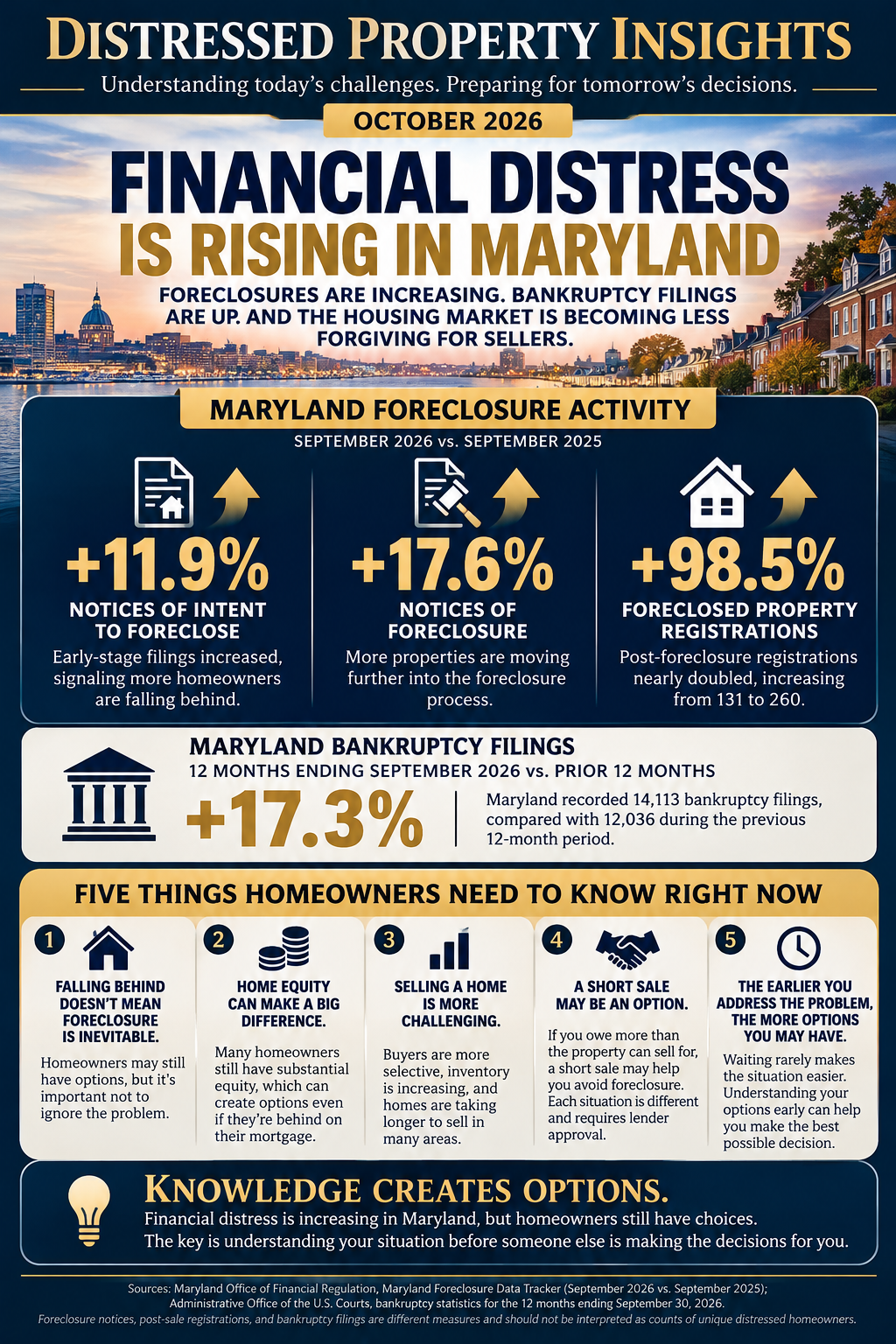
Maryland foreclosed property registrations nearly doubled year over year, while bankruptcy filings increased more than 17%.

Does this mean we're heading toward another 2008 housing crisis? Not necessarily.

But it does raise some important questions about what may be ahead for Maryland homeowners.

📊 Maryland Foreclosure Activity Is Increasing

According to the Maryland Office of Financial Regulation, foreclosure-related activity increased across several categories in the September 2026 comparison.

Foreclosure indicator September 2025 September 2026 Change
Notices of Intent to Foreclose 7,623 8,530 +11.9%
Notices of Foreclosure 755 888 +17.6%
Foreclosed Property Registrations 131 260 +98.5%

The 98.5% increase in foreclosed property registrations is particularly noteworthy.

These registrations are associated with properties that have completed foreclosure, rather than simply homeowners receiving an initial warning.

It's important to understand that these three categories represent different stages of the foreclosure process. They shouldn't be added together or treated as the number of homeowners losing their properties.

And the trend didn't begin this year.

Maryland recorded approximately 91,076 Notices of Intent to Foreclose in 2025, compared with 79,577 in 2024—an increase of approximately 14.5%.

That suggests foreclosure-related financial pressure has been building over more than one reporting period.

Source: Maryland Office of Financial Regulation — Foreclosure Data Tracker

💰 Maryland Bankruptcy Filings Increased 17.3%

Foreclosure statistics aren't the only numbers getting my attention.

According to the Administrative Office of the U.S. Courts, Maryland experienced a significant increase in bankruptcy filings.

During the 12 months ending September 30, 2026:

  • Maryland bankruptcy filings: 14,113

  • Previous 12-month period: 12,036

  • Maryland increase: 17.3%

  • National increase: 11.4%

That's 2,077 additional bankruptcy filings in Maryland compared with the previous year.

Now, bankruptcy and foreclosure are two different things.

Someone filing bankruptcy may not even own a home. And for some homeowners, Chapter 13 bankruptcy may provide a way to address mortgage arrears while protecting their property.

But when bankruptcy filings and foreclosure activity are both increasing, it's reasonable to pay attention to the broader financial pressures affecting households.

Source: U.S. Courts — Bankruptcy Statistics, October 2026

🏡 A Slower Housing Market Can Make Financial Problems More Complicated

Here's where I think these numbers become especially important.

National housing research from Redfin, Realtor.com, and ICE Mortgage Technology is pointing toward a market with fewer active buyers, more price reductions, and increasing mortgage distress.

That doesn't mean every neighborhood is declining or that home prices are collapsing.

But it does mean sellers in many markets are facing more competition.

And there's a big difference between someone who wants to sell and someone who needs to sell.

A homeowner with substantial equity and no financial pressure may be able to wait for the right buyer.

Someone who is three or four months behind on mortgage payments may not have that luxury.

If a property is overpriced, needs repairs, or takes longer than expected to sell, those delays can become especially costly when a foreclosure deadline is approaching.

⚠️ Five Things Maryland Homeowners Should Understand

1. Falling Behind Doesn't Automatically Mean Losing Your Home

Missing mortgage payments is serious, but it doesn't necessarily mean foreclosure is inevitable.

Depending on the circumstances, homeowners may be able to explore mortgage assistance, repayment arrangements, loan modifications, or other loss-mitigation options with their servicer.

The earlier those conversations begin, the better.

2. Home Equity May Provide a Way Out

Many Maryland homeowners have accumulated substantial equity over the years.

Even when someone is behind on mortgage payments, selling the property may allow them to pay off the loan, satisfy other obligations, and potentially walk away with money.

Before making decisions, it's important to understand the property's realistic market value, mortgage payoff, liens, selling expenses, and foreclosure timeline.

3. Pricing and Timing Matter More in a Slower Market

When homes take longer to sell, homeowners facing financial deadlines cannot always afford to test an unrealistic asking price for months.

A realistic pricing strategy, proper marketing, and understanding what buyers are actually willing to pay become even more important.

4. Short Sales Can Still Be an Option

If a homeowner owes more than the property is worth, a short sale may be worth exploring.

A short sale generally requires the mortgage lender or servicer to approve receiving less than the full amount owed from the sale proceeds.

I've personally handled more than 150 short sales during my real estate career.

They're not always simple, and approval is never guaranteed. But in the right circumstances, a short sale can provide an alternative to foreclosure.

5. Waiting Can Reduce Your Options

This may be the most important lesson.

Whether someone is 30 days behind, 90 days behind, or has already received foreclosure paperwork, ignoring the situation rarely helps.

Understanding the available options early can make a tremendous difference.

And sometimes the best solution doesn't involve selling the home at all.

🔮 Will 2027 Bring More Distressed Property Sales?

It's a fair question.

With foreclosure activity increasing, bankruptcy filings rising, and buyers becoming more selective, there are reasons to watch the distressed property market closely heading into 2027.

But there isn't enough evidence to conclude that another nationwide housing crash or foreclosure crisis is inevitable.

Today's homeowners, mortgage structures, equity levels, and housing supply conditions are different from those surrounding the 2008 crisis.

What concerns me is the possibility that more financially stressed homeowners will need to sell at a time when selling may be taking longer.

That's a situation worth preparing for, not panicking over.

🏡 Dan's Take: I've Seen What Happens When Homeowners Wait Too Long

I've been selling real estate since 2004, and I worked through the housing crash, the foreclosure crisis, and the years of short sales that followed.

One thing I've learned is that the biggest problem often isn't the missed mortgage payment itself. It's how long someone waits before addressing it.

I've worked with homeowners who had equity they didn't realize they had. I've worked with people who thought foreclosure was their only option. And I've helped navigate complicated short sales where the goal was simply to find a better outcome than losing the property through foreclosure.

Every situation is different.

Sometimes selling makes sense. Sometimes working directly with the mortgage company is the better path. Sometimes a homeowner needs advice from a housing counselor or an attorney before making any real estate decisions.

But I believe homeowners deserve to understand their choices before those choices start disappearing.

Being behind on your mortgage doesn't mean you've run out of options. Ignoring the situation can eventually take those options away.

Need Help With a Foreclosure, Short Sale, or Distressed Property in Maryland?

If you're facing mortgage difficulties, received a Notice of Intent to Foreclose, inherited a property with financial complications, or simply aren't sure what your home is worth in today's market, I'm happy to have a conversation.

I work with homeowners and families throughout Baltimore County, Baltimore City, Harford County, Anne Arundel County, Cecil County, Howard County, and surrounding Maryland communities.

With more than 20 years of experience and over 150 completed short sales, I can help you understand the real estate side of your situation and explore what may make sense.

No pressure. No judgment. Just a conversation about your options.

I hope you found this information helpful. Every real estate situation is different, and sometimes a quick conversation can make all the difference. If you have questions or just want to understand your options, I'm always happy to help.

All the best,

Dan McDevitt

Dan McDevitt

President, RealVolution Homes Group
Cummings & Company Realtors
Licensed in Maryland & Delaware

Real Estate Questions? Let's Talk.

📅 Schedule A Free 15 Minute Phone Call with Dan

Over 20 Years of Real Estate Experience

About Dan McDevitt

Dan McDevitt is a Baltimore-area Realtor with Cummings & Company Realtors and President of RealVolution Homes Group, licensed in Maryland and Delaware. With more than 20 years of real estate experience, Dan specializes in helping homeowners and families navigate complicated real estate situations brought on by major life events.

His experience includes probate and estate property sales, selling inherited homes, selling a parent's home using a power of attorney (POA), divorce-related property sales, foreclosure and pre-foreclosure situations, short sales, reverse mortgage properties, bankruptcy-related sales, and as-is home sales.

Dan serves Baltimore City, Baltimore County, Harford County, Anne Arundel County, Howard County, and Cecil County, while assisting clients throughout Maryland and Delaware.

Educational information only. This article is not legal, tax, financial, lending, or mortgage servicing advice. FHA HECM rules differ from those for proprietary reverse mortgages, and eligibility, deadlines, and payoff requirements must be confirmed with the servicer and appropriate professionals.

Posted in Dan's Updates
Oct. 26, 2026

Selling a Parent's House With POA in Maryland

Selling a Parent's House Using Power of Attorney in Maryland: What Families Need to Know

Can you sell your parent's house if you have power of attorney?

The short answer is yes, potentially. In Maryland, a properly executed power of attorney can authorize someone to handle the sale of real estate on another person's behalf. But having a power of attorney doesn't automatically mean you have everything you need to sell the house.

The document must grant the appropriate authority, remain legally effective, and satisfy the requirements involved in transferring real estate.

I've worked with families throughout the Baltimore area who find themselves trying to figure this out, often while juggling their own jobs, families, and responsibilities.

Sometimes a parent is moving into assisted living. Sometimes an older relative no longer wants to maintain a house. Other times, someone simply needs help managing their affairs.

Whatever the circumstances, selling the property can become one more major responsibility for a family member who already has plenty on their plate.

The good news is that with the right planning, the process doesn't necessarily have to be overwhelming.

What Does Power of Attorney Actually Mean When Selling a House?

A power of attorney, commonly called a POA, is a legal document that allows one person to act on behalf of another.

The person granting the authority is called the principal. The person receiving that authority is the agent, sometimes referred to as the attorney-in-fact.

Despite the name, the agent does not have to be an attorney. It might be an adult child, spouse, niece, nephew, or another trusted person.

When it comes to selling a home, the important question isn't simply whether someone has power of attorney.

The question is whether that particular document gives them the legal authority to sell the property.

A healthcare power of attorney, for example, is not the same thing as a financial power of attorney authorizing real estate transactions.

That's why I recommend having a Maryland real estate attorney or title company review the document before getting too far into the listing process.

Can You Sell a Parent's House If They're Living in Assisted Living?

This is a situation families frequently have questions about.

A parent may have moved into an assisted living community, but they still own their house. The family is now responsible for figuring out what to do with the property.

Should they keep it? Rent it? Make repairs? Sell it?

And if selling makes the most sense, who is legally authorized to handle everything?

Moving into assisted living does not automatically transfer ownership of a house or give family members permission to sell it.

If the homeowner has granted someone appropriate authority through a valid power of attorney, that person may be able to manage the transaction on the homeowner's behalf.

It's important to understand that the homeowner generally remains the owner. The agent is acting for them, not selling a house they personally own.

The First Thing I Recommend: Get the Power of Attorney Reviewed

One of the easiest ways to create unnecessary delays is to get a property under contract and only then discover there's a problem with the power-of-attorney paperwork.

Before listing, I like to get the title company involved so we can establish a clear path forward.

That means confirming the document authorizes the necessary real estate activities, identifying who is permitted to sign, and determining whether any additional documentation is needed.

Maryland has statutory forms for personal financial and limited powers of attorney. A limited POA can grant authority for particular transactions, including specified real estate activities.

In certain situations, an attorney may recommend preparing a transaction-specific power of attorney rather than relying on an existing document.

The right approach depends on the circumstances and the legal authority available. A Realtor should coordinate the transaction, but legal questions about the validity or scope of a POA belong with a qualified attorney.

Who Signs the Listing Agreement and Real Estate Contract?

This is another common source of confusion.

When a property is being sold through power of attorney, the homeowner doesn't automatically disappear from the paperwork.

The agent signs in a representative capacity on behalf of the homeowner, using the form of signature approved by the title company or attorney.

For example, paperwork might identify the homeowner as the seller and show that an authorized agent is signing on their behalf.

The important thing is to get that established early, rather than discovering at settlement that documents need to be corrected.

Maryland also has specific requirements concerning powers of attorney used to convey real property, including recording requirements associated with the deed.

Should You Fix Up the House or Sell It As-Is?

This is where the legal side of the transaction meets the practical side of real estate.

A family may have the proper authority to sell the home, but that doesn't mean they have the time, money, or desire to spend months preparing it.

I've seen situations where family members are trying to coordinate cleaning, furniture removal, contractors, maintenance, and property access while continuing to manage their own lives.

And one of the biggest misconceptions I encounter is that a house must be completely updated before it can be sold.

It doesn't.

The real question is whether the improvements will produce enough additional value to justify their cost and the time involved.

For example, imagine a house where the kitchen and bathrooms are dated, the flooring shows wear, and the property needs a thorough cleaning.

There may be several reasonable approaches:

  • Sell the property in its current condition.

  • Complete basic cleaning and inexpensive improvements.

  • Make targeted repairs that improve marketability.

  • Undertake a larger renovation if the financial return supports it.

I prefer to evaluate comparable sales, current competition, likely buyer expectations, and estimated improvement costs before recommending a direction.

Sometimes spending a few thousand dollars makes sense. Other times, pricing the home appropriately and allowing the next owner to make the improvements is the better decision.

The goal isn't to make the house perfect. It's to make a smart decision for the homeowner.

What If the Family Members Don't Live Nearby?

Selling a parent's or relative's home can become particularly challenging when the people handling the transaction live outside the immediate area.

Someone needs to coordinate access, meet contractors, review offers, handle inspections, and communicate with the title company.

That doesn't mean every family member needs to be physically present for every step.

When I'm working with someone handling a sale through power of attorney, I try to establish early who has decision-making authority, how they prefer to communicate, and what responsibilities I can help coordinate.

That might include obtaining estimates, arranging property preparation, managing showings, reviewing buyer feedback, or helping the family evaluate offers.

My job isn't just to put the house on the market.

It's to help the people responsible for the transaction understand their options and make informed decisions without creating unnecessary work for them.

What Happens When a Buyer Requests Repairs?

Even when a home is being sold in its current condition, inspection issues may arise depending on the terms of the purchase contract.

A buyer might request repairs, a credit toward closing costs, or another negotiated solution.

Families handling a property through POA may not want to coordinate several contractors, especially if they're already managing other responsibilities.

In some situations, a negotiated credit can be a practical alternative to completing repairs before settlement.

But that doesn't mean every request should automatically be accepted.

I look at the inspection findings, the potential repair costs, the contract terms, the buyer's financing, and the overall transaction before helping the seller evaluate the available options.

A credit also needs to comply with the buyer's loan requirements.

The objective is to find a reasonable solution that protects the homeowner's interests while keeping the transaction moving toward settlement.

Does Power of Attorney Still Work After the Homeowner Dies?

This is an especially important distinction.

A power of attorney generally ends when the person who granted it dies.

If a homeowner passes away before the property is sold, the person holding power of attorney cannot simply continue using that authority to complete the transaction.

The situation may then involve estate administration, a personal representative, and potentially probate proceedings.

The appropriate next steps depend on how the property is titled and the circumstances of the estate.

This is one reason it's important to distinguish selling a home using power of attorney from selling a home through probate. They're related areas of real estate, but they're not the same legal process.

If circumstances change during a transaction, the family should promptly consult the title company and estate attorney.

Five Things I Recommend Before Selling a House Using POA

1. Locate the existing power-of-attorney document. Don't assume that because you can handle banking or medical decisions, you automatically have authority to sell real estate.

2. Have the document reviewed early. A Maryland attorney or title company can help identify potential issues before the home is listed.

3. Understand the property's condition and realistic market value. Decide whether repairs are worthwhile before spending money unnecessarily.

4. Establish one clear communication process. When several relatives are involved, everyone should understand who has authority to make decisions and how information will be shared.

5. Work with professionals familiar with these transactions. Coordinating a POA sale involves more than ordinary listing paperwork. Experience with title requirements, property preparation, family communication, and transaction management can make a meaningful difference.

You Don't Have to Figure Everything Out at Once

If you're responsible for helping a parent or relative sell their house, it's understandable to have questions.

You may not know whether the existing power of attorney is sufficient. You may be unsure whether to renovate, sell as-is, or even where to begin.

And you may be dealing with all of this while balancing your own family and work responsibilities.

My approach is to start by understanding the situation, identifying the available options, and helping you put together a practical plan.

I've spent more than 20 years helping homeowners and families navigate real estate transactions throughout the Baltimore area, including situations involving power of attorney, inherited homes, estate properties, and other major life changes.

If you're trying to figure out what to do with a parent's or relative's home in Maryland, I'm happy to talk through the real estate side of the process and help you understand your next steps.

You don't need to have every answer before making that first call.

I hope you found this information helpful. Every real estate situation is different, and sometimes a quick conversation can make all the difference. If you have questions or just want to understand your options, I'm always happy to help.

All the best,

Dan McDevitt

Dan McDevitt

President, RealVolution Homes Group
Cummings & Company Realtors
Licensed in Maryland & Delaware

Real Estate Questions? Let's Talk.

📅 Schedule A Free 15 Minute Phone Call with Dan

Over 20 Years of Real Estate Experience

About Dan McDevitt

Dan McDevitt is a Baltimore-area Realtor with Cummings & Company Realtors and President of RealVolution Homes Group, licensed in Maryland and Delaware. With more than 20 years of real estate experience, Dan specializes in helping homeowners and families navigate complicated real estate situations brought on by major life events.

His experience includes probate and estate property sales, selling inherited homes, selling a parent's home using a power of attorney (POA), divorce-related property sales, foreclosure and pre-foreclosure situations, short sales, reverse mortgage properties, bankruptcy-related sales, and as-is home sales.

Dan serves Baltimore City, Baltimore County, Harford County, Anne Arundel County, Howard County, and Cecil County, while assisting clients throughout Maryland and Delaware.

Educational information only. This article is not legal, tax, financial, lending, or mortgage servicing advice. FHA HECM rules differ from those for proprietary reverse mortgages, and eligibility, deadlines, and payoff requirements must be confirmed with the servicer and appropriate professionals.

Oct. 25, 2026

Selling an Inherited House As-Is in Baltimore County

Selling an Inherited House As-Is in Baltimore County: Why Renovating Isn't Always the Best Decision

By Dan McDevitt | RealVolution Homes Group | Cummings & Company Realtors

When someone inherits a house in Baltimore County, one of the first questions that often comes up is:

"Should we fix the house up before selling it, or would we be better off selling it as-is?"

It's a reasonable question, especially when the property belonged to a parent or family member who lived there for decades.

Maybe the kitchen hasn't been updated in years. The carpeting is older, the paint and wallpaper are dated, or the floors need attention. The family starts making a list of improvements, and before long, they're wondering whether they need to spend $20,000, $30,000, or more just to get the house ready for the market.

But here's something I've learned after more than 20 years in real estate:

Just because a house needs updating doesn't mean renovating it before selling is the best financial decision.

Sometimes the opportunity is in the property exactly as it sits.

A Real Estate Example: An Estate Property in Dundalk, Maryland

I'm currently preparing an estate property at 3701 North Point Boulevard in Dundalk, Baltimore County, and it's a good example of why I believe every inherited home deserves an individual evaluation before anyone starts spending money on renovations.

The property is a three-bedroom detached Cape Cod with approximately 1,193 square feet of above-grade living space and an additional 752-square-foot unfinished basement.

The interior has areas that would benefit from updating. There are older finishes, carpeting, and flooring that a new owner may want to address.

But here's what caught my attention when evaluating the property.

It's a detached single-family home with a spacious fenced-in yard, two detached garages, a carport, a large deck, and an enclosed porch with sliding glass doors.

Those features are important.

While buyers can replace carpeting, paint walls, or remodel a kitchen, finding a detached home with this kind of outdoor space, parking, and storage can be considerably more challenging.

The property's greatest selling points aren't necessarily inside the house. They're the things that may be difficult or expensive for a buyer to find somewhere else.

That's a completely different way to look at the property's potential.

The Mistake Families Sometimes Make With Inherited Homes

When families inherit a property that hasn't been updated in years, they often compare it to beautifully renovated homes they see online.

They see new kitchens, luxury flooring, fresh paint, and updated bathrooms.

Naturally, they begin thinking they need to do the same thing to compete.

But there are several questions I encourage families to consider before making that decision.

How much will the renovations actually cost?

How long will the work take?

Who is going to manage the contractors?

Will the improvements increase the property's selling price enough to justify the expense?

And perhaps most importantly:

Is there already a buyer willing to purchase the home in its current condition at a price that makes sense for the estate?

That last question is frequently overlooked.

Selling As-Is Doesn't Mean Selling Only to Cash Investors

One misconception I encounter is that a house needing work must automatically be sold to an investor at a deeply discounted price.

That's not necessarily true.

There are buyers who would rather purchase a home at a more affordable price and make improvements over time.

Think about a first-time buyer who has been searching for a townhouse because detached single-family homes seem out of reach.

What if that buyer could purchase a detached home with a fenced yard, garage space, and additional storage for a price comparable to some townhomes?

The home might need new flooring, fresh paint, or kitchen updates. But the buyer may see an opportunity to make those improvements gradually and build potential sweat equity.

Of course, the property still needs to meet the requirements of the buyer's financing program, and not every repair can be postponed. Some buyers may need a renovation loan or another financing solution.

But the important point is that investors aren't necessarily the only audience for an estate property that needs updating.

Why Renovations Don't Always Produce a Dollar-for-Dollar Return

Let's look at a hypothetical example.

Suppose a family is considering spending $30,000 updating an inherited house.

After evaluating comparable properties, the local market, and the improvements being proposed, we determine that the renovations might increase the selling price by $35,000.

At first glance, that sounds like a $5,000 gain.

But what about the additional holding costs, utilities, insurance, property taxes, contractor delays, unexpected repairs, and the time involved?

What happens if the project costs $40,000 instead?

And what if the market changes while the work is being completed?

That's why I don't believe families should automatically renovate an inherited home simply because it needs cosmetic improvements.

The decision should be based on the numbers, the property's condition, the available buyer pool, and the family's priorities.

Sometimes selective improvements make sense.

Sometimes a thorough cleaning, removing unwanted belongings, and completing a few inexpensive repairs can make a meaningful difference.

And sometimes selling the property in its existing condition is the most practical option.

There isn't one answer that works for every estate.

What Buyers May Value More Than a Renovated Kitchen

Let's go back to the estate property on North Point Boulevard.

A buyer might walk into the house and immediately notice the older finishes.

But another buyer may recognize something entirely different.

They may see a detached home instead of a townhouse.

They may see a fenced yard where their children or pets can play.

They may see two garages that could provide parking, storage, or workshop space.

They may see a deck and enclosed porch where they can enjoy time outdoors.

And they may see an unfinished basement that offers storage now and possible future improvements, subject to applicable building and permit requirements.

These are the features I'm focusing on as I prepare to market this property.

Rather than trying to convince buyers that the home is something it isn't, I want to help them understand what it already offers.

A house doesn't have to be completely renovated to represent a worthwhile opportunity.

What an Executor or Personal Representative Should Consider Before Renovating

If you're serving as the personal representative of an estate in Maryland, the decision to spend estate funds on property improvements deserves careful consideration.

Before committing to a renovation, I recommend evaluating several factors:

  • The property's current market value: What are buyers likely to pay in its existing condition?

  • The potential value after improvements: What do comparable renovated homes actually sell for?

  • The true cost of the work: Include possible overruns, carrying costs, and contractor expenses.

  • The estate's available resources: Does the estate have sufficient funds to complete the project without creating unnecessary financial pressure?

  • The timeline: Are there deadlines, ongoing expenses, or other circumstances affecting the sale?

  • The likely buyers: Would the property appeal to owner-occupants, renovation buyers, investors, or a combination?

  • The authority to proceed: Are the proposed expenditures and sale decisions consistent with the personal representative's legal responsibilities and any applicable estate requirements?

A personal representative should coordinate legal or estate-administration questions with the estate attorney.

My role as the real estate professional is to provide the market analysis, explain the selling options, and help the family understand the practical consequences of each approach.

My Approach to Marketing Estate and Inherited Properties

I've worked with homeowners and families facing complicated real estate situations for more than two decades, including probate and estate sales, inherited properties, short sales, foreclosure-related situations, and homes being sold without extensive repairs.

One thing I've learned is that the right strategy starts with understanding the property and the people involved.

Not every family wants to coordinate contractors.

Not every estate has the funds for renovations.

And not every property needs a complete makeover to attract qualified buyers.

For a home like 3701 North Point Boulevard, the marketing strategy is to highlight the characteristics that distinguish it from other properties: detached living, yard space, multiple garages, covered parking, and the flexibility to make improvements over time.

That approach doesn't guarantee a particular sale price or outcome. It simply gives the property a chance to reach buyers who may recognize its potential.

Inherited a House in Baltimore County? Understand Your Options Before Spending Money

If you've inherited a house in Dundalk, Essex, Parkville, Perry Hall, Towson, or anywhere else in Baltimore County, don't assume you need to renovate it before putting it on the market.

And don't assume your only alternative is accepting a low cash offer.

There may be several reasonable paths forward, depending on the property, the local market, the estate's circumstances, and your goals.

Before spending thousands of dollars on improvements, find out what the property could sell for as-is, what realistic improvements might add to its value, and whether the additional expense and time are worthwhile.

Sometimes the smartest decision isn't to change the house.

It's to recognize its existing value, identify the right buyers, and develop a strategy that makes sense for the family.

 you found this information helpful. Every real estate situation is different, and sometimes a quick conversation can make all the difference. If you have questions or just want to understand your options, I'm always happy to help.

All the best,

Dan McDevitt

Dan McDevitt

President, RealVolution Homes Group
Cummings & Company Realtors
Licensed in Maryland & Delaware

Real Estate Questions? Let's Talk.

📅 Schedule A Free 15 Minute Phone Call with Dan

Over 20 Years of Real Estate Experience

About Dan McDevitt

Dan McDevitt is a Baltimore-area Realtor with Cummings & Company Realtors and President of RealVolution Homes Group, licensed in Maryland and Delaware. With more than 20 years of real estate experience, Dan specializes in helping homeowners and families navigate complicated real estate situations brought on by major life events.

His experience includes probate and estate property sales, selling inherited homes, selling a parent's home using a power of attorney (POA), divorce-related property sales, foreclosure and pre-foreclosure situations, short sales, reverse mortgage properties, bankruptcy-related sales, and as-is home sales.

Dan serves Baltimore City, Baltimore County, Harford County, Anne Arundel County, Howard County, and Cecil County, while assisting clients throughout Maryland and Delaware.

Educational information only. This article is not legal, tax, financial, lending, or mortgage servicing advice. FHA HECM rules differ from those for proprietary reverse mortgages, and eligibility, deadlines, and payoff requirements must be confirmed with the servicer and appropriate professionals.

Oct. 23, 2026

Baltimore Estate Condo Sale | Falls Garden Success Story

How We Successfully Sold an Estate-Owned Condo in Falls Garden, Baltimore, MD, for $280,000

A real Maryland estate property sale success story — and why experience, communication, and persistence matter when selling a home after a loved one's passing.

Selling a home as part of an estate can be complicated. Between managing a loved one's belongings, coordinating with family members, preparing the property for sale, and navigating the real estate transaction itself, personal representatives often have a lot more on their plates than the average home seller.

And sometimes, even when everything seems to be moving in the right direction, unexpected challenges arise.

That's exactly what happened with our recent estate sale at 6943 Clearwind Court #6943C in the Falls Garden community of Baltimore, Maryland.

After navigating an initial contract that didn't make it to settlement, additional inspections, repair negotiations, and contractor coordination, we successfully closed the property on October 22, 2026, for $280,000.

It was a strong comparable sale for the Falls Garden community and a successful outcome for the estate.

But getting there wasn't without its challenges.

The Property: A Unique Two-Level Condo in Falls Garden

Located in the Falls Garden community in Baltimore's 21209 ZIP code, this top-floor condominium offered several features that made it stand out.

The property included:

  • Two bedrooms and two full bathrooms

  • Approximately 1,699 square feet of finished living space, including the upper-level loft, based on professional floor-plan measurements

  • Soaring vaulted ceilings

  • A wood-burning fireplace

  • A private covered balcony

  • An upper-level loft offering additional flexible living space

  • Granite countertops, stainless steel appliances, and a kitchen island

  • Access to the community swimming pool

Unlike many traditional condominiums, this property featured a two-level layout and the added privacy of having no neighbors living directly above it.

Those were important selling points when positioning the condo against other available properties.

Selling a Property That's Part of an Estate

This wasn't a traditional homeowner sale.

The condominium was owned by an estate, meaning the transaction involved a personal representative responsible for handling the property as part of the estate administration process.

Estate sales often require additional coordination, particularly when family members are managing belongings, making decisions about property condition, and working through the responsibilities associated with settling an estate.

My approach in these situations is to make the real estate side of the process as manageable as possible.

That means explaining the options, providing realistic market information, coordinating the details, and helping the estate make informed decisions without creating unnecessary pressure.

For this property, our goal was straightforward: position the condo competitively, attract a qualified buyer, and get the transaction successfully to settlement.

When the First Contract Didn't Work Out

We initially secured a buyer and negotiated a contract.

Unfortunately, the transaction encountered challenges following the home inspection.

The buyer raised concerns about several property conditions, including potential moisture-related issues. As negotiations progressed, the buyer requested concessions and repairs that required further evaluation.

Because this was a condominium, some of the concerns also raised questions about potential condominium association responsibilities.

Rather than make assumptions or promise repairs that might not be within the estate's control, we worked to gather information, communicate with the appropriate parties, and evaluate the requests.

Ultimately, that first contract did not proceed to settlement.

Losing a buyer is frustrating for any seller. For an estate, it can be particularly stressful because ongoing condominium fees, utilities, insurance, and other carrying costs may continue while the property remains unsold.

But an unsuccessful contract doesn't necessarily mean the property cannot be sold successfully.

Sometimes the most important thing is to reassess the situation, learn from the experience, and keep moving forward.

A New Buyer and a $280,000 Contract

We returned the property to the market and secured another buyer.

This time, the offer came in at $280,000.

The new buyer was using mortgage financing, which meant we needed to navigate the normal financing and appraisal requirements in addition to the home inspection process.

The inspection resulted in additional negotiations involving HVAC servicing, a reported biological growth concern, and plumbing issues in the primary bathroom.

We worked through those negotiations and reached an agreement involving a $2,000 buyer credit and specific repairs to be addressed before settlement.

I also coordinated with a contractor who handled both HVAC and plumbing services, helping simplify the process and keep the transaction moving toward closing.

This is one of the areas where experience and a reliable network of contractors can make a difference.

When you're dealing with an estate property, especially one approaching settlement, coordinating the right people at the right time can help prevent small issues from becoming major obstacles.

Successfully Closed: October 22, 2026

After working through the challenges, the estate successfully sold the condominium.

The final result:

  • Property: 6943 Clearwind Court #6943C, Baltimore, MD 21209

  • Community: Falls Garden

  • Property type: Two-bedroom, two-bath condominium with loft

  • Seller: Estate

  • Final sale price: $280,000

  • Settlement date: October 22, 2026

The sale represented a strong comparable result within the Falls Garden community.

Most importantly, the property was sold, the transaction was completed, and the estate could move forward without continuing to manage an unsold condominium.

What Other Maryland Personal Representatives Can Learn From This Sale

Every estate is different, but this transaction illustrates several things worth understanding before selling an inherited or estate-owned property.

1. You don't necessarily need to renovate everything before selling.

The right strategy depends on the property's condition, the local market, the estate's financial circumstances, and the likely return on any improvements.

Sometimes targeted repairs and effective marketing make more financial sense than extensive renovations.

2. Inspection negotiations require careful consideration.

Not every buyer request is reasonable, and not every inspection finding requires the seller to perform a repair.

Understanding the actual concerns, evaluating the costs, and negotiating practical solutions can make a significant difference.

3. Condominium sales come with additional considerations.

Condominium fees, association documents, maintenance responsibilities, and potential association-related repairs can all affect the transaction.

It's important to understand those issues early.

4. A contract falling through doesn't mean the sale is over.

Our first buyer didn't make it to settlement.

We continued marketing the property, secured another buyer, and ultimately sold it for $280,000.

5. Experience with estate sales matters.

Selling a property after a loved one's passing isn't just about putting a sign in the yard.

It's about helping people navigate a real estate transaction during what can already be a difficult and emotionally demanding time.

Another Important Consideration: What If an Estate Doesn't Have Money for Repairs?

While this wasn't necessary for the Falls Garden sale, another challenge I sometimes help estate representatives navigate is a lack of available cash for repairs or improvements.

An estate may have substantial equity in a property but very little money available to prepare it for sale.

This is where experience and established relationships with reliable contractors can make a difference.

In some situations, I can connect estate representatives with contractors who are willing to complete necessary repairs or improvements and receive payment from the seller's proceeds at settlement, rather than requiring the estate to pay upfront.

These arrangements aren't available in every situation. They must be agreed upon in writing and coordinated with the personal representative, contractor, and settlement company in advance. Payment also depends on sufficient proceeds being available and any necessary approvals.

But when this is an option, it can provide families with flexibility they might not realize exists.

For example, imagine an inherited property needs $5,000 in repairs that could potentially increase its sale price by $15,000 or $20,000.

If the estate doesn't have $5,000 available, the personal representative might assume selling completely as-is is the only choice.

But if a contractor is willing to complete the work and be paid at settlement, the estate may have an opportunity to improve the property's presentation and potentially increase its net proceeds.

Of course, not every repair produces that kind of return, and there is never a guarantee that improvements will increase a property's value.

Sometimes selling completely as-is is the smartest financial decision. Other times, a few strategic improvements can help attract more buyers, reduce inspection issues, and potentially achieve a stronger sale price.

My job is to help personal representatives understand their options and make informed decisions that serve the estate's best interests.

Need to Sell an Inherited Home or Estate Property in Maryland?

I'm Dan McDevitt with RealVolution Homes Group at Cummings & Co. Realtors.

I've been helping Maryland homeowners buy and sell real estate since 2004, with extensive experience in estate and inherited-property sales, probate-related real estate, short sales, foreclosure situations, reverse mortgages, and other complicated property transactions.

Whether you're a personal representative handling an estate, an out-of-state family member responsible for a property in Maryland, or someone who recently inherited a home and isn't sure where to begin, I'm happy to help you understand your options.

Not every property needs to be renovated. Not every estate needs the same selling strategy. And you shouldn't have to figure everything out on your own.

If you're responsible for selling an inherited home, condo, or estate property in Maryland, let's talk about your situation and the options available to you.

I hope you found this information helpful. Every real estate situation is different, and sometimes a quick conversation can make all the difference. If you have questions or just want to understand your options, I'm always happy to help.

All the best,

Dan McDevitt

Dan McDevitt

President, RealVolution Homes Group
Cummings & Company Realtors
Licensed in Maryland & Delaware

Real Estate Questions? Let's Talk.

📅 Schedule A Free 15 Minute Phone Call with Dan

Over 20 Years of Real Estate Experience

About Dan McDevitt

Dan McDevitt is a Baltimore-area Realtor with Cummings & Company Realtors and President of RealVolution Homes Group, licensed in Maryland and Delaware. With more than 20 years of real estate experience, Dan specializes in helping homeowners and families navigate complicated real estate situations brought on by major life events.

His experience includes probate and estate property sales, selling inherited homes, selling a parent's home using a power of attorney (POA), divorce-related property sales, foreclosure and pre-foreclosure situations, short sales, reverse mortgage properties, bankruptcy-related sales, and as-is home sales.

Dan serves Baltimore City, Baltimore County, Harford County, Anne Arundel County, Howard County, and Cecil County, while assisting clients throughout Maryland and Delaware.

Educational information only. This article is not legal, tax, financial, lending, or mortgage servicing advice. FHA HECM rules differ from those for proprietary reverse mortgages, and eligibility, deadlines, and payoff requirements must be confirmed with the servicer and appropriate professionals.

Oct. 7, 2026

Reverse Mortgage Foreclosure in Maryland: How to Avoid It

How to Avoid Foreclosure on a Reverse Mortgage Property in Maryland (Baltimore Guide)

Think you can't lose a home to foreclosure because it has a reverse mortgage? Think again.

One of the biggest misconceptions I encounter about reverse mortgages is that once a homeowner takes one out, they never have to worry about foreclosure again.

Unfortunately, that's not how it works.

While a reverse mortgage generally eliminates the requirement to make monthly principal-and-interest mortgage payments, it doesn't eliminate the homeowner's other responsibilities. And when those responsibilities aren't met, foreclosure can become a very real possibility.

I've worked with homeowners and families throughout the Baltimore area dealing with complicated property situations, including reverse mortgages, estate sales, short sales, and foreclosure.

One thing I've learned over the years is that many people don't realize they have a problem until they've already received a notice from the mortgage company.

The good news? Depending on the circumstances, there may still be options.

Why Would a Reverse Mortgage Go Into Foreclosure?

Most reverse mortgages are federally insured Home Equity Conversion Mortgages (HECMs).

Unlike a traditional mortgage, a HECM generally doesn't require monthly principal-and-interest payments while the borrower meets the loan's requirements.

However, there are several situations that can trigger a default or make the loan due and payable.

1. Unpaid Property Taxes or Homeowners Insurance

This is one of the biggest issues homeowners need to understand.

Even with a reverse mortgage, you're generally responsible for paying property taxes, maintaining homeowners insurance, and covering other required property charges.

If those obligations aren't met, the mortgage servicer may advance money to cover them. That doesn't mean the problem disappears.

2. The Property Is No Longer the Primary Residence

Reverse mortgages generally require the borrower to occupy the property as their principal residence.

For example, if a homeowner moves permanently into assisted living or a nursing home, the loan may eventually become due.

For a HECM, an absence of more than 12 consecutive months in a healthcare facility can trigger repayment requirements, subject to applicable co-borrower and eligible-spouse protections.

3. The Homeowner Passes Away

When the last surviving borrower dies, and no eligible spouse protection applies, the reverse mortgage generally becomes due and payable.

This can create an unexpected situation for children or family members who inherit the property.

4. The Property Isn't Properly Maintained

A reverse mortgage also requires the homeowner to maintain the property.

Significant unresolved maintenance problems can create additional complications with the lender.

The bottom line is simple: A reverse mortgage eliminates certain monthly payments. It doesn't eliminate the possibility of foreclosure.

What Should You Do If You Receive a Reverse Mortgage Foreclosure Notice?

First, don't ignore it.

I can't emphasize that enough.

Whether you're the homeowner, an adult child helping an elderly parent, or the personal representative handling an estate, the worst thing you can do is put the notice aside and assume there's nothing you can do.

Start by contacting the mortgage servicer and finding out exactly why the loan is in default or has become due.

Ask these questions:

  • What specifically triggered the default?

  • What amount, if any, is needed to correct the problem?

  • What is the current loan balance?

  • Has the loan been declared due and payable?

  • Has foreclosure actually been initiated?

  • What options and deadlines apply to this particular loan?

Get the answers in writing whenever possible.

If the issue involves unpaid taxes, insurance, or required repairs, there may be opportunities to correct the default or request assistance.

If the loan is due because the borrower passed away or permanently moved out, the solution may involve paying off the loan, refinancing, or selling the property.

The important thing is understanding which problem you're actually trying to solve.

Can You Sell a House With a Reverse Mortgage Before Foreclosure?

Yes. And in some situations, selling the property may be the most practical solution.

This is especially true when the homeowner has permanently moved out, the family has inherited the property, or maintaining the home is no longer financially realistic.

A reverse mortgage doesn't mean the bank owns the house.

The homeowner still holds title, and the property can generally be sold, subject to the loan payoff and any other applicable requirements.

Let's look at an example.

Suppose a Baltimore County homeowner has a reverse mortgage balance of $225,000.

The property is worth approximately $350,000.

If the homeowner decides to sell, the reverse mortgage would generally be paid off at settlement, along with applicable selling expenses.

Any remaining proceeds would belong to the homeowner or, in an estate situation, be handled through the estate.

That's a substantially different outcome than simply allowing a property with available equity to proceed through foreclosure.

Of course, every situation is different, and the actual payoff, property value, and selling expenses need to be verified.

What If the Reverse Mortgage Balance Is More Than the House Is Worth?

Here's another area where families often become unnecessarily discouraged.

Imagine someone inherits a property in Baltimore with a reverse mortgage balance of $325,000.

Unfortunately, the home is only worth approximately $275,000.

The family may assume they're stuck with a property they can't sell because the mortgage exceeds its value.

That isn't necessarily true.

For an FHA-insured HECM that has become due and payable, there are provisions that can allow an eligible sale for at least 95% of the property's current appraised value when the loan balance exceeds the home's value.

The applicable appraisal, lender requirements, and approval process matter.

This is not a blanket rule that every reverse mortgage can be sold for any amount a buyer offers.

But it does mean that a property being underwater doesn't automatically eliminate the possibility of a sale.

Families should also understand that federally insured HECMs have protections that generally prevent borrowers or their estates from being personally responsible for a shortfall beyond the home's value.

Proprietary reverse mortgages may have different terms.

What Happens When Someone Inherits a House With a Reverse Mortgage?

This is particularly important for families handling probate and estate properties.

When a parent or other loved one passes away, family members are often dealing with funeral arrangements, estate paperwork, personal belongings, and dozens of other responsibilities.

The house may not be their first priority.

Unfortunately, the reverse mortgage servicer may already be moving through its own process.

For a HECM, heirs may receive a notice that the loan is due and payable. The notice can establish an initial 30-day response period, although additional time may be available under applicable rules.

Extensions may be possible when heirs are actively working to sell the property or arrange repayment, but they aren't something families should assume will happen automatically.

The personal representative or appropriate authorized party should communicate with the servicer promptly, provide requested documentation, and understand the deadlines.

If the property is going to be sold, starting the process early can make a significant difference.

For more information, see my related article:

What Happens to a House With a Reverse Mortgage After Death? (Baltimore Guide)

Five Steps That May Help Prevent Reverse Mortgage Foreclosure

If you're dealing with a reverse mortgage that's in default or approaching foreclosure, here's where I would start.

1. Contact the mortgage servicer immediately.

Find out why the loan is in default, request a current payoff statement, and confirm any deadlines.

2. Determine whether the default can be corrected.

If unpaid property taxes or insurance are the issue, ask about repayment options, available assistance, and whether the servicer offers an applicable loss-mitigation solution.

3. Get an accurate assessment of the property's value.

You need to understand whether there's equity in the home and whether selling could satisfy the reverse mortgage.

4. Speak with a HUD-approved housing counselor or qualified attorney.

Especially when foreclosure proceedings have begun, getting advice about your legal rights and available assistance is important.

5. Develop a realistic plan instead of waiting.

Whether the goal is keeping the property, selling it, or resolving an estate, deadlines matter.

Maryland homeowners can contact the Maryland Homeowner Assistance Hotline at 1-877-462-7555 for referrals to foreclosure-prevention counseling and legal resources.

The Bottom Line: Don't Let a Reverse Mortgage Become an Avoidable Foreclosure

Reverse mortgages can provide important financial flexibility for older homeowners.

But when circumstances change—whether because of unpaid expenses, declining health, a move into assisted living, or the death of a loved one—the loan can become complicated very quickly.

I've seen throughout my real estate career how difficult these situations can become when families wait too long to address them.

Sometimes the best solution is finding a way to keep the property.

Other times, selling the house before foreclosure may preserve equity, reduce expenses, and allow the homeowner or family to move forward.

The important thing is understanding your options before someone else makes the decision for you.

If you're dealing with a reverse mortgage property in Baltimore City, Baltimore County, Harford County, Anne Arundel County, Howard County, or the surrounding Maryland area, I'm happy to help you understand the real estate side of the situation.

No pressure. Just an opportunity to review the property, discuss its value, and determine whether selling makes sense.

I hope you found this information helpful. Every real estate situation is different, and sometimes a quick conversation can make all the difference. If you have questions or just want to understand your options, I'm always happy to help.

All the best,

Dan McDevitt

Dan McDevitt

President, RealVolution Homes Group
Cummings & Company Realtors
Licensed in Maryland & Delaware

Real Estate Questions? Let's Talk.

📅 Schedule A Free 15 Minute Phone Call with Dan

Over 20 Years of Real Estate Experience

About Dan McDevitt

Dan McDevitt is a Baltimore-area Realtor with Cummings & Company Realtors and President of RealVolution Homes Group, licensed in Maryland and Delaware. With more than 20 years of real estate experience, Dan specializes in helping homeowners and families navigate complicated real estate situations brought on by major life events.

His experience includes probate and estate property sales, selling inherited homes, selling a parent's home using a power of attorney (POA), divorce-related property sales, foreclosure and pre-foreclosure situations, short sales, reverse mortgage properties, bankruptcy-related sales, and as-is home sales.

Dan serves Baltimore City, Baltimore County, Harford County, Anne Arundel County, Howard County, and Cecil County, while assisting clients throughout Maryland and Delaware.

Educational information only. This article is not legal, tax, financial, lending, or mortgage servicing advice. FHA HECM rules differ from those for proprietary reverse mortgages, and eligibility, deadlines, and payoff requirements must be confirmed with the servicer and appropriate professionals.

Sept. 18, 2026

2604 Roselawn Avenue Baltimore MD 21214 | Renovated Hamilton Home for Sale

If you've been looking for a completely renovated home in Hamilton where the work went well beyond paint, flooring and a new kitchen, take a look at 2604 Roselawn Avenue.

This home has been extensively renovated from top to bottom, with major improvements including a new roof, siding, windows, electrical, plumbing, HVAC, water heater and insulation, along with a new kitchen, renovated bathrooms, flooring, fixtures and finishes throughout.

And there's a lot more space here than you might expect from looking at the house from the street.

Today's professional floor-plan measurements show approximately 2,144 square feet of finished space across three levels, including approximately 1,342 square feet above grade and 802 finished square feet on the lower level.

2604 Roselawn Avenue
Baltimore, MD 21214
4 Bedrooms | 2 Full Bathrooms | 2,144 Finished Sq. Ft.

Take a 3D Walk Through 2604 Roselawn Avenue

You don't have to wait for a showing to start exploring the house.

We've created a complete Matterport 3D walkthrough, so you can virtually walk through 2604 Roselawn Avenue from your phone, tablet or computer.

👉 TAKE THE 3D VIRTUAL TOUR On Homes.com 

Like What You See? Schedule a Private Showing

This Was Much More Than a Cosmetic Renovation

One of the biggest things I want buyers to understand about this house is how much work went into the things you don't necessarily see in the photographs.

The renovation included a new roof, siding, windows, electrical, plumbing, HVAC, water heater and professionally installed insulation throughout the home.

That's important because there's a big difference between renovating a house and simply making an older house look new.

The kitchen, bathrooms, flooring and fixtures are the fun things you immediately notice. The mechanical systems and work behind the walls are what make this renovation different from a basic cosmetic update.

A Brand-New Kitchen at the Center of the Home

The kitchen turned out beautifully, with new cabinetry, quartz countertops, stainless-steel appliances, gas cooking and a large center island providing additional prep space, storage and seating.

The kitchen flows naturally into the dining and living areas, giving the main level a comfortable, open feel.

There's also a gas fireplace in the living room, which gives the house some character that you don't always find after a complete renovation.

More Than 2,100 Square Feet of Finished Space

This is one of the easiest things to miss if you're only looking at basic public-record information online.

The professional floor plan measured approximately:

1,037 sq. ft. — Main Level
305 sq. ft. — Finished Upper Level
802 sq. ft. — Finished Lower Level

That's approximately 2,144 square feet of finished space across three levels.

The main level includes two bedrooms and a completely renovated full bathroom.

The finished upper level provides another large, private bedroom with its own dedicated heating and cooling system.

And then there's the lower level.

A Finished Lower Level That Adds Real Space

With approximately 802 finished square feet, the lower level isn't an afterthought.

There's a large finished recreation/family room, additional bedroom space, a second completely renovated full bathroom with tiled shower, dedicated laundry area, storage and separate mechanical space.

Two sump pumps have also been installed as part of the improvements to the lower level.

Whether you need additional sleeping space, room to spread out, a second living area or simply more flexibility, the lower level adds a lot to this house.

One of My Favorite Spaces Is Right Up Front

The enclosed front room gets a ton of natural light and gives you a little extra space you might not expect.

It works really well as a home office, sitting room, reading room or flex space.

If you work from home, this is especially useful because you can create a dedicated workspace without sacrificing one of the bedrooms.

Deck, Fenced Yard, Driveway & Detached Garage

The improvements aren't limited to the inside.

Out back you'll find a rebuilt rear deck overlooking the fenced backyard, giving you plenty of room for a grill, table or outdoor seating.

You've also got something that's always nice to have in Baltimore: off-street driveway parking and a detached one-car garage.

What's It Like Living in Hamilton?

This is where I'd make the blog different from Zillow and the other property portals.

Hamilton is part of the larger Hamilton-Lauraville area of Northeast Baltimore, centered around the Harford Road corridor. Visit Baltimore specifically highlights the area for its independent shopping and food scene while still maintaining the feel of an established residential neighborhood.

If you're a coffee person, local Baltimore roaster Zeke's Coffee has its café at 4719 Harford Road. Zeke's actually got its start in Northeast Baltimore and has been part of the area since 2006.

For restaurants, Silver Queen Cafe is right on Harford Road in Hamilton and focuses on Maryland-influenced, locally sourced food, including brunch on the weekends. Another neighborhood option is Maggie's Farm, which also emphasizes locally sourced ingredients.

The Harford Road corridor also gives residents access to locally owned shops, cafés and neighborhood businesses. Visit Baltimore highlights everything from books and records to locally made goods along the Hamilton-Lauraville corridor.

And when you want some green space, Herring Run Park is one of Northeast Baltimore's major outdoor resources. Visit Baltimore describes it as a 375-acre woodland oasis, while Baltimore City's park materials document Herring Run as part of the city's park system.

That's part of what I like about this section of Northeast Baltimore: you're buying a detached home in an established residential neighborhood while still having the restaurants, coffee shops, local businesses and green space of the Hamilton-Lauraville area nearby.

→ EXPLORE HOMES FOR SALE IN HAMILTON

Want to See 2604 Roselawn Avenue in Person?

The pictures and 3D tour will give you a really good feel for the house, but there's still nothing like walking through it yourself.

If you'd like to schedule a private showing of 2604 Roselawn Avenue, Baltimore, MD 21214, reach out and I'll get you through it.

→ SCHEDULE A PRIVATE SHOWING

Dan McDevitt
RealVolution Homes Group
Cummings & Company Realtors

Own a Home in Hamilton?

If you own a home in Hamilton, Hamilton Hills, Lauraville or elsewhere in Northeast Baltimore and you're wondering what it could sell for, I'm happy to take a look.

One thing this property illustrates really well is why an online estimate can't see the entire picture.

Condition matters. Renovations matter. Finished lower-level space matters. Garages, lots and location matter. And what buyers are actually paying for comparable homes right now matters.

→ FIND OUT WHAT YOUR HOME COULD SELL FOR

I hope you found this information helpful. Every real estate situation is different, and sometimes a quick conversation can make all the difference. If you have questions or just want to understand your options, I'm always happy to help.

All the best,

Dan McDevitt

Dan McDevitt

President, RealVolution Homes Group
Cummings & Company Realtors
Licensed in Maryland & Delaware

Real Estate Questions? Let's Talk.

📅 Schedule A Free 15 Minute Phone Call with Dan

Over 20 Years of Real Estate Experience

About Dan McDevitt

Dan McDevitt is a Baltimore-area Realtor with Cummings & Company Realtors and President of RealVolution Homes Group, licensed in Maryland and Delaware. With more than 20 years of real estate experience, Dan specializes in helping homeowners and families navigate complicated real estate situations brought on by major life events.

His experience includes probate and estate property sales, selling inherited homes, selling a parent's home using a power of attorney (POA), divorce-related property sales, foreclosure and pre-foreclosure situations, short sales, reverse mortgage properties, bankruptcy-related sales, and as-is home sales.

Dan serves Baltimore City, Baltimore County, Harford County, Anne Arundel County, Howard County, and Cecil County, while assisting clients throughout Maryland and Delaware.

Educational information only. This article is not legal, tax, financial, lending, or mortgage servicing advice. FHA HECM rules differ from those for proprietary reverse mortgages, and eligibility, deadlines, and payoff requirements must be confirmed with the servicer and appropriate professionals.

Posted in Dans Listings
Sept. 17, 2026

Behind on Your Mortgage in Maryland? 1.9 Million U.S. Homeowners Are 30+ Days Late

Being 30 days behind on your mortgage is a warning sign—not a foreclosure sentence.

If you’ve missed a mortgage payment, the temptation is to panic—or worse, avoid dealing with it altogether.

Neither helps.

New national mortgage data caught my attention because approximately 1.932 million properties were at least 30 days past due on their mortgage but not yet in foreclosure as of May 31, 2026. That was 188,000 more than a year earlier.

Those are big numbers.

But if you're a homeowner in Baltimore or anywhere in Maryland struggling with your mortgage, there's something much more important than the headline:

Being behind doesn't necessarily mean you're losing your house.

What it does mean is that it's time to understand your options.

1.9 Million Delinquent Mortgages Doesn't Mean 1.9 Million Foreclosures

Let's get something straight because scary housing headlines travel fast.

ICE reported a national mortgage delinquency rate of 3.50% in May. The monthly increase was influenced significantly by May ending on a Sunday, which pushed some payment processing into the following business day. Overall mortgage performance remained below January 2020 delinquency levels.

So no, I'm not telling you 1.9 million homes are about to be foreclosed on.

But there's another part of the report I am watching.

There were 577,000 properties at least 90 days delinquent but not yet in foreclosure, up 111,000 from a year earlier. Active foreclosure inventory reached approximately 280,000 loans—34% higher than a year earlier and the highest level in six years, although the foreclosure rate remained below pre-pandemic levels.

That's worth paying attention to.

30 Days Late Is When You Should Start Asking Questions

If you're behind, don't wait until you're staring at a foreclosure sale date to figure out what you're going to do.

Federal mortgage-servicing rules generally prevent a servicer from making the first foreclosure notice or filing until a mortgage is more than 120 days delinquent, with limited exceptions. Servicers also generally have early-intervention responsibilities when borrowers become delinquent.

Maryland has additional foreclosure procedures and notices. The Maryland Office of Financial Regulation says a Notice of Intent to Foreclose is a warning that a foreclosure action could be filed and generally must be mailed at least 45 days before the foreclosure action may be filed.

That's why 30 days late and 120 days late are two very different situations.

Time creates options.

Waiting takes them away.

If you want a deeper explanation, I've also written a guide on What Happens After You Miss Mortgage Payments in Maryland?


Before Selling, Find Out Whether You Can Save the Home

I'm a Realtor, but I'm going to tell you something that might sound strange coming from one:

Selling shouldn't automatically be your first move.

If you want to keep the house, start by contacting your mortgage servicer and finding out what loss-mitigation options may be available.

Depending on the loan and circumstances, those options can include a repayment plan, forbearance or loan modification. The Consumer Financial Protection Bureau also recommends contacting a HUD-approved housing counselor, who can provide foreclosure-avoidance assistance at little or no cost.

The goal isn't to sell everybody's house.

The goal is to figure out the solution that makes sense.

Sometimes Selling Is Actually the Best Foreclosure-Avoidance Strategy

Here's something else homeowners sometimes miss:

Being behind on the mortgage and being underwater are not the same thing.

You could owe $250,000 on a property worth $375,000 and be three months behind.

That's a problem—but potentially a very solvable one.

If there's enough equity to pay the mortgage, liens and selling expenses, a traditional sale may allow you to pay everything off and preserve the remaining equity rather than letting the situation progress toward foreclosure.

That's why one of the first things I want to know is:

What is the property realistically worth, and what do you actually owe?

Those two numbers can completely change the conversation.

And What If You Owe More Than the House Is Worth?

That's where a short sale may become part of the conversation.

A short sale involves selling the property when the proceeds aren't enough to satisfy the mortgage and obtaining the lender or servicer's required approval for the transaction. The CFPB includes short sales among the loss-mitigation possibilities that may be available to some borrowers.

I've been working with short sales for many years, and one lesson keeps repeating itself:

Earlier is better.

Waiting until you're deep into foreclosure makes an already complicated transaction harder.

I've put together two additional resources if this describes your situation:

What Is a Short Sale and How Does It Work in Maryland?

and

Can You Sell Your House If You Owe More Than It's Worth?

I hope you found this information helpful. Every real estate situation is different, and sometimes a quick conversation can make all the difference. If you have questions or just want to understand your options, I'm always happy to help.

All the best,

Dan McDevitt

Dan McDevitt

President, RealVolution Homes Group
Cummings & Company Realtors
Licensed in Maryland & Delaware

Real Estate Questions? Let's Talk.

📅 Schedule A Free 15 Minute Phone Call with Dan

Over 20 Years of Real Estate Experience

About Dan McDevitt

Dan McDevitt is a Baltimore-area Realtor with Cummings & Company Realtors and President of RealVolution Homes Group, licensed in Maryland and Delaware. With more than 20 years of real estate experience, Dan specializes in helping homeowners and families navigate complicated real estate situations brought on by major life events.

His experience includes probate and estate property sales, selling inherited homes, selling a parent's home using a power of attorney (POA), divorce-related property sales, foreclosure and pre-foreclosure situations, short sales, reverse mortgage properties, bankruptcy-related sales, and as-is home sales.

Dan serves Baltimore City, Baltimore County, Harford County, Anne Arundel County, Howard County, and Cecil County, while assisting clients throughout Maryland and Delaware.

Educational information only. This article is not legal, tax, financial, lending, or mortgage servicing advice. FHA HECM rules differ from those for proprietary reverse mortgages, and eligibility, deadlines, and payoff requirements must be confirmed with the servicer and appropriate professionals.

Posted in Short Sales