


Maryland Foreclosures and Bankruptcy Filings Are Rising: What Homeowners Need to Know in 2026
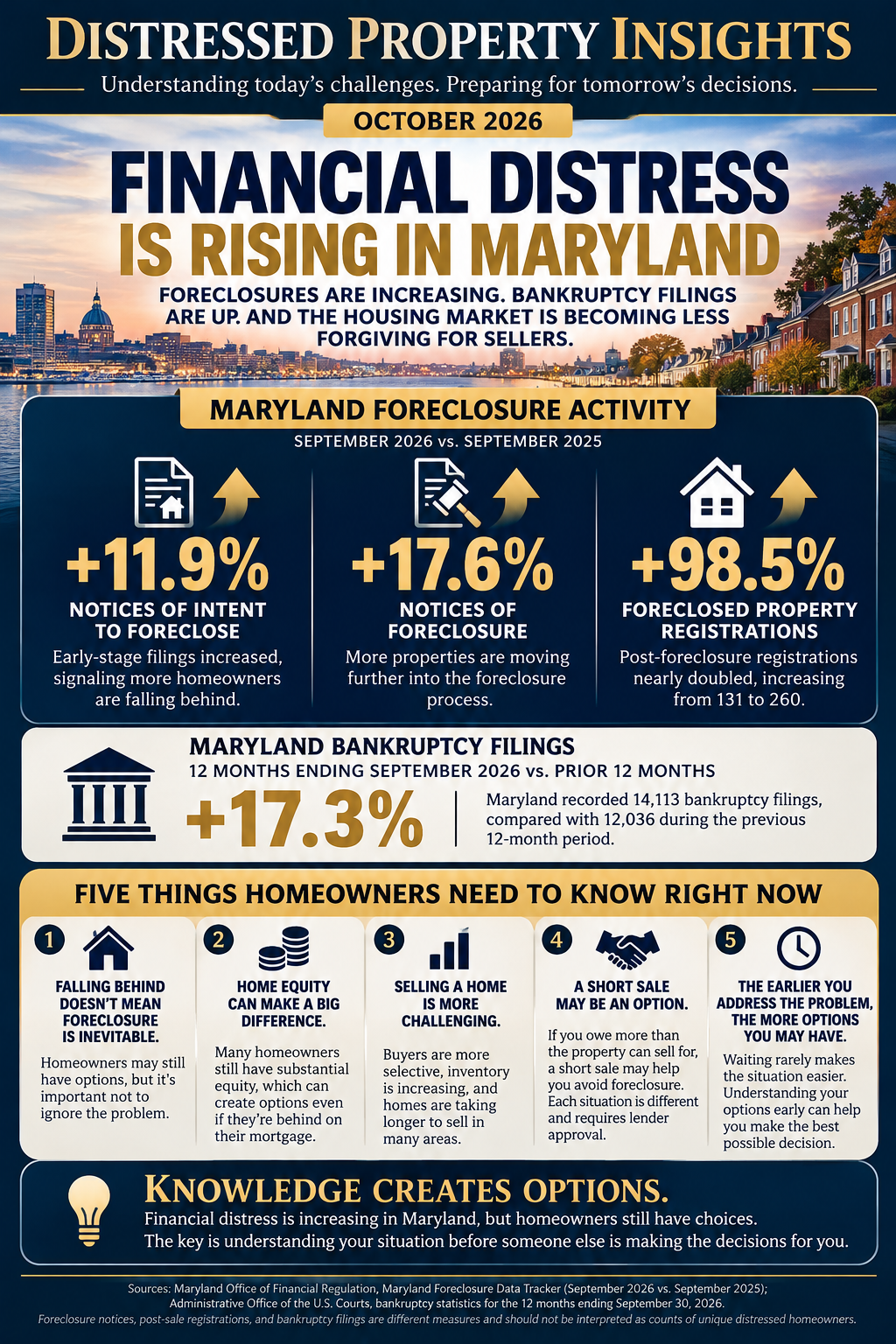
Distressed Property Insights | October 2026
By Dan McDevitt | RealVolution Homes Group at Cummings & Company Realtors
Something is changing in Maryland's housing market, and it's worth paying attention to.
I've been selling real estate since 2004, and lately I've been dealing with more distressed property situations than I have in quite a few years.
Homeowners falling behind on mortgage payments. Families facing foreclosure deadlines. Properties that need to be sold under difficult circumstances.
And now, the latest foreclosure and bankruptcy statistics are showing signs of increasing financial pressure.
Maryland foreclosed property registrations nearly doubled year over year, while bankruptcy filings increased more than 17%.
Does this mean we're heading toward another 2008 housing crisis? Not necessarily.
But it does raise some important questions about what may be ahead for Maryland homeowners.
📊 Maryland Foreclosure Activity Is Increasing
According to the Maryland Office of Financial Regulation, foreclosure-related activity increased across several categories in the September 2026 comparison.
| Foreclosure indicator | September 2025 | September 2026 | Change |
|---|---|---|---|
| Notices of Intent to Foreclose | 7,623 | 8,530 | +11.9% |
| Notices of Foreclosure | 755 | 888 | +17.6% |
| Foreclosed Property Registrations | 131 | 260 | +98.5% |
The 98.5% increase in foreclosed property registrations is particularly noteworthy.
These registrations are associated with properties that have completed foreclosure, rather than simply homeowners receiving an initial warning.
It's important to understand that these three categories represent different stages of the foreclosure process. They shouldn't be added together or treated as the number of homeowners losing their properties.
And the trend didn't begin this year.
Maryland recorded approximately 91,076 Notices of Intent to Foreclose in 2025, compared with 79,577 in 2024—an increase of approximately 14.5%.
That suggests foreclosure-related financial pressure has been building over more than one reporting period.
Source: Maryland Office of Financial Regulation — Foreclosure Data Tracker
💰 Maryland Bankruptcy Filings Increased 17.3%
Foreclosure statistics aren't the only numbers getting my attention.
According to the Administrative Office of the U.S. Courts, Maryland experienced a significant increase in bankruptcy filings.
During the 12 months ending September 30, 2026:
-
Maryland bankruptcy filings: 14,113
-
Previous 12-month period: 12,036
-
Maryland increase: 17.3%
-
National increase: 11.4%
That's 2,077 additional bankruptcy filings in Maryland compared with the previous year.
Now, bankruptcy and foreclosure are two different things.
Someone filing bankruptcy may not even own a home. And for some homeowners, Chapter 13 bankruptcy may provide a way to address mortgage arrears while protecting their property.
But when bankruptcy filings and foreclosure activity are both increasing, it's reasonable to pay attention to the broader financial pressures affecting households.
Source: U.S. Courts — Bankruptcy Statistics, October 2026
🏡 A Slower Housing Market Can Make Financial Problems More Complicated
Here's where I think these numbers become especially important.
National housing research from Redfin, Realtor.com, and ICE Mortgage Technology is pointing toward a market with fewer active buyers, more price reductions, and increasing mortgage distress.
That doesn't mean every neighborhood is declining or that home prices are collapsing.
But it does mean sellers in many markets are facing more competition.
And there's a big difference between someone who wants to sell and someone who needs to sell.
A homeowner with substantial equity and no financial pressure may be able to wait for the right buyer.
Someone who is three or four months behind on mortgage payments may not have that luxury.
If a property is overpriced, needs repairs, or takes longer than expected to sell, those delays can become especially costly when a foreclosure deadline is approaching.
⚠️ Five Things Maryland Homeowners Should Understand
1. Falling Behind Doesn't Automatically Mean Losing Your Home
Missing mortgage payments is serious, but it doesn't necessarily mean foreclosure is inevitable.
Depending on the circumstances, homeowners may be able to explore mortgage assistance, repayment arrangements, loan modifications, or other loss-mitigation options with their servicer.
The earlier those conversations begin, the better.
2. Home Equity May Provide a Way Out
Many Maryland homeowners have accumulated substantial equity over the years.
Even when someone is behind on mortgage payments, selling the property may allow them to pay off the loan, satisfy other obligations, and potentially walk away with money.
Before making decisions, it's important to understand the property's realistic market value, mortgage payoff, liens, selling expenses, and foreclosure timeline.
3. Pricing and Timing Matter More in a Slower Market
When homes take longer to sell, homeowners facing financial deadlines cannot always afford to test an unrealistic asking price for months.
A realistic pricing strategy, proper marketing, and understanding what buyers are actually willing to pay become even more important.
4. Short Sales Can Still Be an Option
If a homeowner owes more than the property is worth, a short sale may be worth exploring.
A short sale generally requires the mortgage lender or servicer to approve receiving less than the full amount owed from the sale proceeds.
I've personally handled more than 150 short sales during my real estate career.
They're not always simple, and approval is never guaranteed. But in the right circumstances, a short sale can provide an alternative to foreclosure.
5. Waiting Can Reduce Your Options
This may be the most important lesson.
Whether someone is 30 days behind, 90 days behind, or has already received foreclosure paperwork, ignoring the situation rarely helps.
Understanding the available options early can make a tremendous difference.
And sometimes the best solution doesn't involve selling the home at all.
🔮 Will 2027 Bring More Distressed Property Sales?
It's a fair question.
With foreclosure activity increasing, bankruptcy filings rising, and buyers becoming more selective, there are reasons to watch the distressed property market closely heading into 2027.
But there isn't enough evidence to conclude that another nationwide housing crash or foreclosure crisis is inevitable.
Today's homeowners, mortgage structures, equity levels, and housing supply conditions are different from those surrounding the 2008 crisis.
What concerns me is the possibility that more financially stressed homeowners will need to sell at a time when selling may be taking longer.
That's a situation worth preparing for, not panicking over.
🏡 Dan's Take: I've Seen What Happens When Homeowners Wait Too Long
I've been selling real estate since 2004, and I worked through the housing crash, the foreclosure crisis, and the years of short sales that followed.
One thing I've learned is that the biggest problem often isn't the missed mortgage payment itself. It's how long someone waits before addressing it.
I've worked with homeowners who had equity they didn't realize they had. I've worked with people who thought foreclosure was their only option. And I've helped navigate complicated short sales where the goal was simply to find a better outcome than losing the property through foreclosure.
Every situation is different.
Sometimes selling makes sense. Sometimes working directly with the mortgage company is the better path. Sometimes a homeowner needs advice from a housing counselor or an attorney before making any real estate decisions.
But I believe homeowners deserve to understand their choices before those choices start disappearing.
Being behind on your mortgage doesn't mean you've run out of options. Ignoring the situation can eventually take those options away.
Need Help With a Foreclosure, Short Sale, or Distressed Property in Maryland?
If you're facing mortgage difficulties, received a Notice of Intent to Foreclose, inherited a property with financial complications, or simply aren't sure what your home is worth in today's market, I'm happy to have a conversation.
I work with homeowners and families throughout Baltimore County, Baltimore City, Harford County, Anne Arundel County, Cecil County, Howard County, and surrounding Maryland communities.
With more than 20 years of experience and over 150 completed short sales, I can help you understand the real estate side of your situation and explore what may make sense.
No pressure. No judgment. Just a conversation about your options.
I hope you found this information helpful. Every real estate situation is different, and sometimes a quick conversation can make all the difference. If you have questions or just want to understand your options, I'm always happy to help.
All the best,
Dan McDevitt
President, RealVolution Homes Group
Cummings & Company Realtors
Licensed in Maryland & Delaware
Real Estate Questions? Let's Talk.
📅 Schedule A Free 15 Minute Phone Call with DanOver 20 Years of Real Estate Experience
About Dan McDevitt
Dan McDevitt is a Baltimore-area Realtor with Cummings & Company Realtors and President of RealVolution Homes Group, licensed in Maryland and Delaware. With more than 20 years of real estate experience, Dan specializes in helping homeowners and families navigate complicated real estate situations brought on by major life events.
His experience includes probate and estate property sales, selling inherited homes, selling a parent's home using a power of attorney (POA), divorce-related property sales, foreclosure and pre-foreclosure situations, short sales, reverse mortgage properties, bankruptcy-related sales, and as-is home sales.
Dan serves Baltimore City, Baltimore County, Harford County, Anne Arundel County, Howard County, and Cecil County, while assisting clients throughout Maryland and Delaware.
Educational information only. This article is not legal, tax, financial, lending, or mortgage servicing advice. FHA HECM rules differ from those for proprietary reverse mortgages, and eligibility, deadlines, and payoff requirements must be confirmed with the servicer and appropriate professionals.